The
facts that you will see below, bear a double significance:
1.
They prove that the
Christian Church, even from its very beginning, was no different to
today’s Orthodox Church, with its temples, icons, and bishops
and
2.
They prove that not only
the Christians, but EVEN THE JEWS comprehended the term “idol” with its
proper meaning, which is: “a depiction of God”. This is why
both Christians and Jews of the first Christian era had ONLY images
(icons) in their places of worship.
And here
is the evidence:
Dura
Europos was a Hellenic city, built by Nicator the Seleucid on the right
bank of the river Euphrates, near Palmyra. It was besieged by Rome in
165 A.D. and was destroyed by the Persian Sasanides in 256 A.D.. Most
of the edifices of the city were discovered under the sand, and were in
perfect condition. Among them, was a Judean Synagogue as well as the
most ancient of all Christian temples, which has remained intact to this
day.
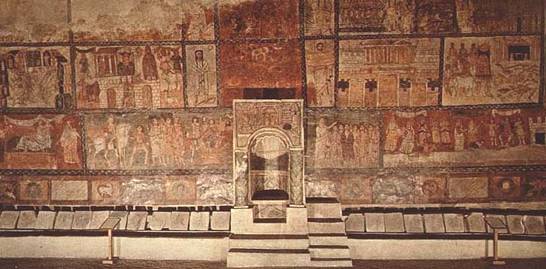 Photograph of the Judean Synagogue
in Dura Europos.
The murals date back to 235 A.D..
It was discovered in 1921.
Photograph of the Judean Synagogue
in Dura Europos.
The murals date back to 235 A.D..
It was discovered in 1921.
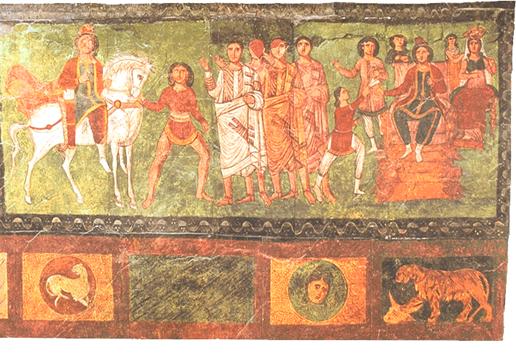 Detail from the Synagogue. Scene
from the Book of Esther.
The resemblance to Byzantine
Hagiography is remarkable. This is natural, as Hellenistic art forms were
applied.
Detail from the Synagogue. Scene
from the Book of Esther.
The resemblance to Byzantine
Hagiography is remarkable. This is natural, as Hellenistic art forms were
applied.
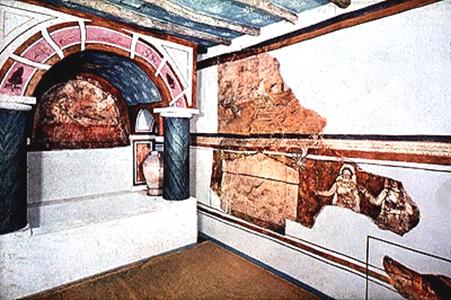 The
most ancient of all Christian churches is also preserved in Dura Europos.
The
most ancient of all Christian churches is also preserved in Dura Europos.
Sections of the iconography can be seen on the wall. Opposite the entrance
stood the elevated Altar, the “«tablinum».
The
Archaeologists tell us that this was where the liturgies took place, on this
altar, by the Bishop. It dates back to 230-260 A.D.
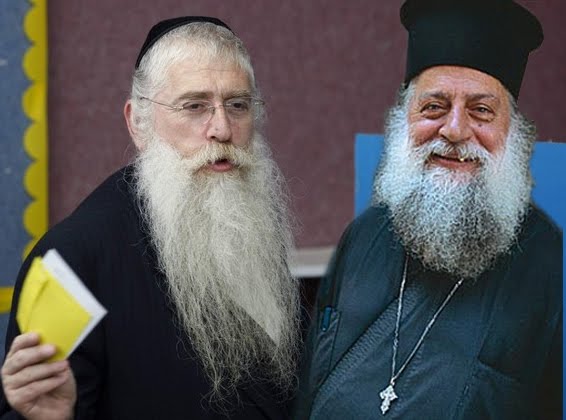 An Orthodox Jewish Rabbi and an Orthodox
Christian Priest. Notice the similarities...
An Orthodox Jewish Rabbi and an Orthodox
Christian Priest. Notice the similarities...
As for the Christian temple, Mrs.
Despina Iosif (a doctor of History at the University of London) in the magazine
“Historical Themes” (issue No.30, June 2004, pages 8-19, in her article titled
“A moral dilemma of the proto-Christian communities”), wrote the following:
"The edifice had initially been
built at the beginning of the 3rd century, in close proximity to
other houses and temples. It was not, however, an ordinary, humble abode. Its
owner must have been an affluent and prominent member of the community. In the
year 232/233, the house underwent alterations, with the intention that a section
of it was to be used as a meeting place and a house of worship for Christians (domus
ecclesiae). This is the earliest example of an above-ground Christian temple
that we know of to this day. The first Christians used to congregate in private
homes before the 3rd century A.D., when the construction of edifices
dedicated exclusively to Christian worship began. This house is of special
interest for the additional reason that on one of its walls are certain etched
representations of three mounted soldiers. Perhaps the owner was a Roman officer
who had decided to cede a part of the house to local Christians, himself being a
Christian also.”
It is our hope that the above
document will help Protestant believers revise the misconception that they
support, which is that the Church of Christ altered the supposed “simplicity” of
worship that it had in the beginning. It should also make them more careful and
less blasphemous, when they refer to the Christians’ use of temples, bishops and
holy icons as “idolatry”. We have just shown here, that this has been the
Christian custom since the beginning.
(*)
*********************************************
Not much later, at about the
time the
Dura Synagogue came into being, the Palestinian Talmud records the
grudging recognition of Jewish art ( Abodah Zarah 48d ): “In
the days of Rabbi Jochanan, men began to paint pictures on the walls,
and he did not hinder them”, and “In the days of Rabbi
Abun, men began to make designs of mosaics and he did not hinder them.”
( Abodah Zarah 42b ).
To the above passages, we add
still another, Targum Pseudo-Jonathan on Leviticus 26:1.
This Aramaic translation first paraphrases the prohibition against
making idols and graven images and such figures in stone as men bow down
to. Then the text makes an exception: “But a stone column carved
with images and likeness you may make upon the premises of your
sanctuaries, but not to worship them.” At last we hear the
correct application of the second commandment.
Jacob Milgrom,
“The
Dura Synagogue and Visual Midrash,”
Scriptures for the Modern World, ed.
Paul R.
Cheesman and C. Wilfred Griggs
(Provo, UT:
Religious Studies Center, Brigham Young
University, 1984), 29–60.
Source: http://orthodox-apologetics.blogspot.com/2010/08/talmudic-icons.html
*********************************************
Iconographic depiction in the Old Testament
Exodus 25:18 And thou shalt make two cherubims of gold, of
beaten work shalt thou make them, in the two ends of the mercy seat. 19 And
make one cherub on the one end, and the other cherub on the other end:
even of the mercy seat shall ye make the cherubims on the two ends
thereof. 20 And the cherubims shall stretch forth their
wings on high, covering the mercy seat with their wings, and their faces
shall look one to another; toward the mercy seat shall the faces of the
cherubims be. 22 And there I will meet with thee, and
I will commune with thee from above the mercy seat, from between the two
cherubims which are upon the ark of the testimony, of all things which I
will give thee in commandment unto the children of Israel.
Exodus 26:1 Moreover thou shalt make the tabernacle with
ten curtains of fine twined linen, and blue, and purple, and scarlet:
with cherubims of cunning work shalt thou make them.
Exodus 26:31 And thou shalt make a veil of blue, and
purple, and scarlet, and fine twined linen of cunning work: with
cherubims shall it be made.
Exodus 36:8 And every wise hearted man among them that
wrought the work of the tabernacle made ten curtains of fine twined
linen, and blue, and purple, and scarlet: with cherubims of cunning work
made he them.
Exodus 36:35 And he made a veil of blue, and purple, and
scarlet, and fine twined linen: with cherubims made he it of cunning
work.
Exodus 37:7 And he made two cherubims of gold, beaten out
of one piece made he them, on the two ends of the mercy seat; 8 One
cherub on the end on this side, and another cherub on the other end on
that side: out of the mercy seat made he the cherubims on the two ends
thereof. 9 And the cherubims spread out their wings on
high, and covered with their wings over the mercy seat, with their faces
one to another; even to the mercy seatward were the faces of the
cherubims.
Numbers 7:89 And when Moses was gone into the tabernacle
of the congregation to speak with him, then he heard the voice of one
speaking unto him from off the mercy seat that was upon the ark of
testimony, from between the two cherubims: and he spake unto him.
The Temple of King Solomon:
1 Kings 6:23 And within the oracle he made two cherubims
of olive tree, each ten cubits high. 24 And five cubits
was the one wing of the cherub, and five cubits the other wing of the
cherub: from the uttermost part of the one wing unto the uttermost part
of the other were ten cubits. 25 And the other cherub
was ten cubits: both the cherubims were of one measure and one size. 26 The
height of the one cherub was ten cubits, and so was it of the other
cherub. 27 And he set the cherubims within the inner
house: and they stretched forth the wings of the cherubims, so that the
wing of the one touched the one wall, and the wing of the other cherub
touched the other wall; and their wings touched one another in the midst
of the house. 28 And he overlaid the cherubims with
gold. 29 And he carved all the walls of the house
round about with carved figures of cherubims and palm trees and open
flowers, within and without. 32 The two doors also
were of olive tree; and he carved upon them carvings of cherubims and
palm trees and open flowers, and overlaid them with gold, and spread
gold upon the cherubims, and upon the palm trees. 35 And
he carved thereon cherubims and palm trees and open flowers: and covered
them with gold fitted upon the carved work.
1 Kings 7:29 And on the borders that were between the
ledges were lions, oxen, and cherubims: and upon the ledges there was a
base above: and beneath the lions and oxen were certain additions made
of thin work. 36 For on the plates of the ledges
thereof, and on the borders thereof, he graved cherubims, lions, and
palm trees, according to the proportion of every one, and additions
round about.
1 Kings 8:6 And the priests brought in the ark of the
covenant of the LORD unto his place, into the oracle of the house, to
the most holy place, even under the wings of the cherubims. 7 For
the cherubims spread forth their two wings over the place of the ark,
and the cherubims covered the ark and the staves thereof above.
1 Chronicles 28:18 And for the altar of incense refined
gold by weight; and gold for the pattern of the chariot of the cherubims,
that spread out their wings, and covered the ark of the covenant of the
LORD.
2 Chronicles 3:7 He overlaid also the house, the beams,
the posts, and the walls thereof, and the doors thereof, with gold; and
graved cherubims on the walls. 10 And in the most holy
house he made two cherubims of image work, and overlaid them with gold. 11 And
the wings of the cherubims were twenty cubits long: one wing of the one
cherub was five cubits, reaching to the wall of the house: and the other
wing was likewise five cubits, reaching to the wing of the other
cherub. 12 And one wing of the other cherub was five
cubits, reaching to the wall of the house: and the other wing was five
cubits also, joining to the wing of the other cherub. 13 The
wings of these cherubims spread themselves forth twenty cubits: and they
stood on their feet, and their faces were inward. 14 And
he made the vail of blue, and purple, and crimson, and fine linen, and
wrought cherubims thereon.
2 Chronicles 5:7 And the priests brought in the ark of the
covenant of the LORD unto his place, to the oracle of the house, into
the most holy place, even under the wings of the cherubims: 8 For
the cherubims spread forth their wings over the place of the ark, and
the cherubims covered the ark and the staves thereof above.
*********************************************
(*) Especially for this point, we
would also like to refer our readers to many more related references, in other
articles of ours.:
SOURCES OF ICONS AND INFORMATION ON DURA EUROPOS
|
