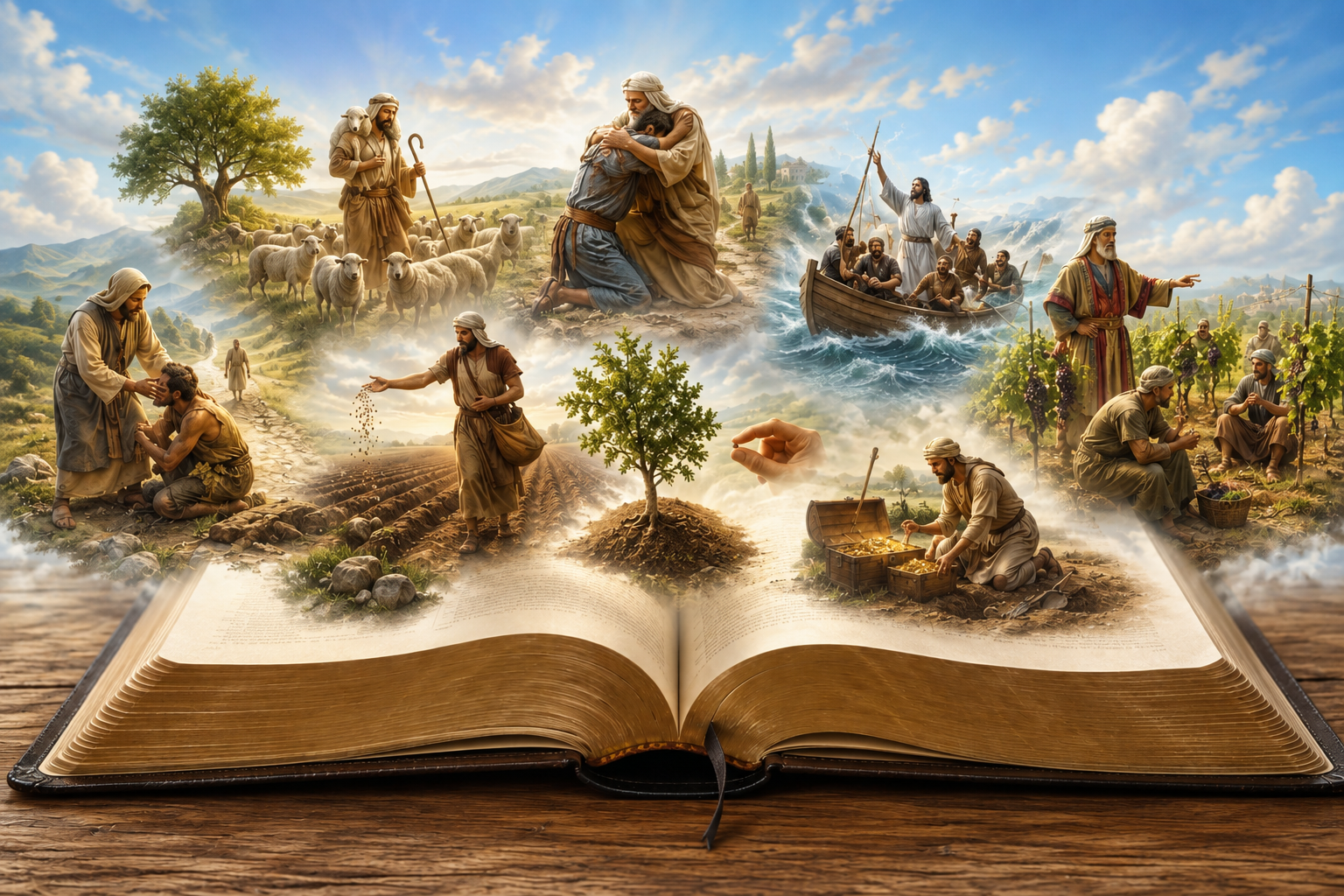
The Sacrament of Book
|
In Saint John’s vision of heaven, attention is drawn to a unique object.
There are the four-and-twenty elders, there is a “sea of glass.” There
is a throne with One seated upon it. But attention is drawn to what the
One holds in His hand: a book. Some translations describe it as a
scroll. Its distinctive feature is the seven seals, each of which will
be opened as the mystical drama is revealed.
But…the book. Is it a scroll? The word in the Greek original is biblion.
It is ambiguous in that in antiquity, biblion could be either a scroll
or a book. It is the root from which we get our word Bible. Its form is
not particularly important. What matters is that it is something that
contains words. It holds revelation. It makes known the truth. In Saint
John’s vision, the only one worthy to open the book is the “Lamb who was
slain.”
Some tell us that we have entered a world that is post-book, digital
text, or audio readers having replaced them. Long before that
replacement, and a necessary step toward our present dystopia, was the
disenchantment of books themselves. To a degree, this began with the
printing press and the rabid proliferation of texts.
The
Reformation was driven by texts – though in the form of pamphlets. They
were the emails and memes of their age. Some historical studies point to
tens of thousands of religious pamphlets flooding various cities during
the times of greatest turmoil. In a society where the printing press was
relatively new, where people actually owned very few (if any) books,
this sudden explosion of material to be read cannot be overlooked. Prior
to this explosion, books were rare, texts were thought of as inherently
authoritative. Suddenly, they were everywhere.
When
a book was the product of hand-copying, it carried a worth that is hard
to estimate. Indeed, the book (and its words) had a different quality
altogether. It is worth noting that when God gave commandments to Moses,
He wrote some form of them on tablets of stone with His own finger. (Ex.
31:18)
We say of the Scriptures that they are “inspired” (literally,
“God-breathed” 2Tim. 3:16). Whether by His finger or by His breath,
there is a unique character to the words found in these writings. To my
mind, the least acceptable approach to reading sacred texts is what is
often described today as “literal.” In this view, the words are inert
and no different than words found anywhere else, with the exception of
being “literally” true. Much of this approach is driven by the
Reformation where neither Church nor Tradition need play any role in
reading – the words mean just what they say. The abject failure of such
a reading can be seen in the chaos of denominationalism. It doesn’t
work. In Orthodoxy, it is perhaps best to think of the Scriptures as sacrament. The Seventh Council said, “Icons do with color what Scripture does with words.” By the same token, I think we can say, “Scripture does with words what icons do with color.” An icon is not a photograph – it’s better and more complete. There is an iconic character to the Scriptures, more in some places than in others. They are also sacramental in character.
Think of Saint John in the Revelation: Revelation 10:9: "So I went to the angel and told him to give me the little scroll. And he said to me, “Take and eat it; it will make your stomach bitter, but in your mouth it will be sweet as honey.”
or in the case of Ezekiel:
"And he said to me,
'Son of man, eat whatever you find here. Eat this scroll, and go, speak
to the house of Israel.' So I opened my mouth, and he gave me this
scroll to eat. And he said to me, 'Son of man, feed your belly with this
scroll that I give you and fill your stomach with it.' Then I ate it,
and it was in my mouth as sweet as honey.”
These are interesting passages. In neither case is the Apostle or
Prophet told to read the scroll. Instead, they eat it.
In Orthodoxy, the Book of the
Gospels is bound separately and rests on the altar (iconically
representing the imagery of the Lamb’s Book in Revelation). On many
occasions, the Gospels are presented to the laity for veneration (to
kiss). In the sacrament of Holy Unction, the gospel is opened and placed
on the head of the person being anointed. They are told that the hand of
God is the book. The text itself is quite sacramental.
How do we read a sacrament? One of the difficulties of pure literalism
is its sense of mastery, that the reader is greater than the text. The
text is trapped in its own letters and must obey our reading – quite in
keeping with Reformation Protestant theology. Any book can be read
literally. Indeed, most books are read that way. This is a mistake when
it comes to the Scriptures.
Saint Maximus the Confessor described three incarnations of
the Logos (Word): in creation, in the Scriptures, in the flesh. In very
rich language, meditating on a work by Saint Gregory the Theologian,
which describes the incarnation as the Logos “becoming thick,”
Saint Maximus says that the Logos is hidden: “without origin in
things that have a beginning; invisible in things that are seen;
incapable of being touched in all that is palpable.” In the
Scriptures Christ is hidden beneath letters, syllables, etc. Christ
Himself is described in the gospels of intentionally speaking in
parables, hiding His meaning beneath their words.
This is not to deny a literal meaning. When Christ is described as
raising a man from the dead (for example), it certainly means that
He raised a man from the dead.
Nevertheless, such a reading
does not exhaust the meaning, nor does it fully capture it. Christ is
Ηidden within and beneath the letters and is
found by those who seek Him. Learning to seek Him in our reading is an
essential part of the Christian life.
In the Scriptures, we read that
Christ took bread, blessed, broke, and gave it to His disciples saying,
“Take, eat. This is my body which is given for you for the
remission of sins…” The Church continues to obey this
commandment and discerns within and beneath the letter (the bread), a
communion with the true Body of Christ. We eat His flesh and drink His
blood.
Of course, it is often ironic
that those who champion literalism are often among the leaders of those
who say that these verses do not mean what they say.
The reading of the Scriptures is embodied in their use within the
liturgical life of the Church. There, the signs, symbols, parables, and
hidden character of the Logos is revealed. However, it is quite often
revealed in poetry and song, in paradox and contradiction. It is in our
participation in the life of the Church that Christ is revealed in us,
the mystery is made known. Our reading of the Scriptures in a
sacramental manner is best fulfilled within the Church and our life
within the Church.
It is worth noting that Saint Maximus used this same imagery for
describing creation itself. The whole of creation is given to us to be
“read” as the Body of Christ. For me, this is a great mystery, one that
I suspect is largely unknown in our time. The lives of the saints often
speak of creation in such a manner – creation’s groaning in travail is
given voice.
Christ invoked the image of the finger of God when He said, “If
I by the finger of God I cast out demons, then the Kingdom of God has
come upon you.” (Lk. 1:20)
This is a key to reading the Scriptures, and possibly reading everything
else as well. The Scriptures are God-breathed, written by the finger of
God. We will never master them. By the same token, His finger has mapped
the heavens and drawn all of creation. We need to become true disciples
and learn to hear and read the Word of God as He gives Himself to us.
And nothing less.
|
Article published in English on: 4-9-2026.
Last update: 4-9-2026.