SHOW THEM NO MERCY!
The Biblical story of Child Sacrifice in the worship of the gods
or
Israel from Exodus to Exile and Return
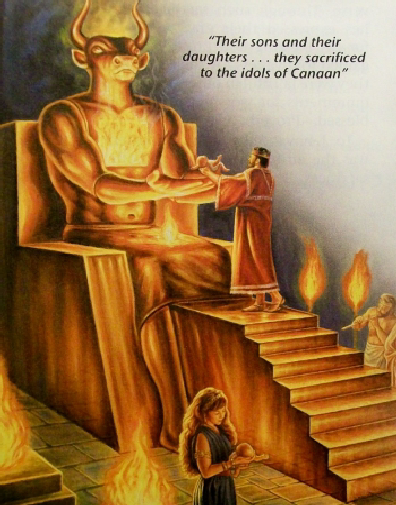
Article revised on 29th August 2025
All biblical quotes but one are from the NRSV Anglicised
*************************
Psalm 106 states the thesis of this paper. After describing the problems that the people of Israel had in keeping to God’s ways in the Exodus, then on their entry into the Promised Land …
"34They did not destroy the peoples as the LORD commanded them, 35but they mingled with the nations and learned to do as they did. 36They served their idols, which became a snare to them. 37They sacrificed their sons and their daughters to the demons. 38They poured out innocent blood, the blood of their sons and daughters, whom they sacrificed to the idols of Canaan, and the land was polluted with blood. 39Thus they became unclean by their acts; and prostituted themselves in their doings. 40Then the anger of the LORD was kindled against his people and he abhorred his heritage; 41he gave them into the hands of the nations, so that those who hated them ruled over them. 42Their enemies oppressed them, And they were brought into subjection under their power. 43Many times he delivered them, but they were rebellious in their purposes, and were brought low through their iniquity. 44Nevertheless, he regarded their distress when he heard their cry. 45For their sake he remembered his covenant, and showed compassion according to the abundance of his steadfast love. 46He caused them to be pitied by all who held them captive."
Preface
Many of these ‘show them no mercy’ episodes and related wars described in the Bible have contested historical accuracy. My aim is not to deal with single episodes but to show that these terrible fragments are parts of a very long Biblical story of the horror of child sacrifice from Genesis, through the Old Testament, the Apocrypha, and into the words of Jesus - which seems not to have been done before, and may modify some of the claims on historicity of these episodes in this very long story of horror, and thus may give an explanation of those terrible episodes in the history of Israel. A book which deals with a few of these biblical episodes, their intent and historicity, is by Paul Copan and Matthew Flannagan, "Did God Really Command Genocide? Coming to Terms with the Justice of God", Baker Books, Grand Rapids, Mich., 2014. In this book a few episodes are agonizingly analysed in isolation, with no sense that these may be parts of a very long continuous story. These authors select bits of these episodes that they think were written by the human authors of the biblical text, which are the bits that they don’t like, and leave God as the author of what they can get along with. In this fragmentation the presentation of an overall theological history of Israel is missed, and their idea of the nature of the biblical text is not clear to me.
Contents
Introduction
1. Setting up a theocracy, the story of Israel.
1.1. Why a theocracy?
1.2. Abraham and Isaac
1.3. Abraham shown the Promised Land and sent away
1.4. To the Promised Land, “show them no mercy!”?
1.5. Don’t intermarry in the Promised Land
1.6. The choice of God (monotheism) or gods (polytheisms)
1.7. In the Promised Land, Joshua and Judges
1.8. Kill all the women and all the children!?
2. Israel’s demand for Royalty
3. Solomon: 1 Kings 11 the hinge of Israel’s history
4. The split of Israel
4.1. The Northern Kingdom – wipeout of the ten tribes of ‘Israel’.
4.2. The Southern Kingdom – 'Israel’ to ‘Judaea’, ‘Israelites’ to ‘Jews’, to wipeout, and a remnant into Exile.
4.3. A remnant of the remnant returned from Exile
5. The Prophets and Psalmist
6. The Inter-Testamental period, the Apocrypha.
7. Child sacrifice the worst sin
8. Atheists on human sacrifice in religion
9. Timetable
10. The New Testament
10.1. The reason for exile - Molech
10.2. Valley of Ben Hinnom to 'Gehenna' to 'Hell'
10.3. Jesus on children.
10.4. Kill, cook, then eat – from sacrifice to eucharist
11. Jewish revolts of 70A.D. and 135A.D., Judaea to ‘Palestine’.
12. Christian burnings at the stake!?
13. Non-biblical child sacrifice
14. Conclusion
************************************************************************************************
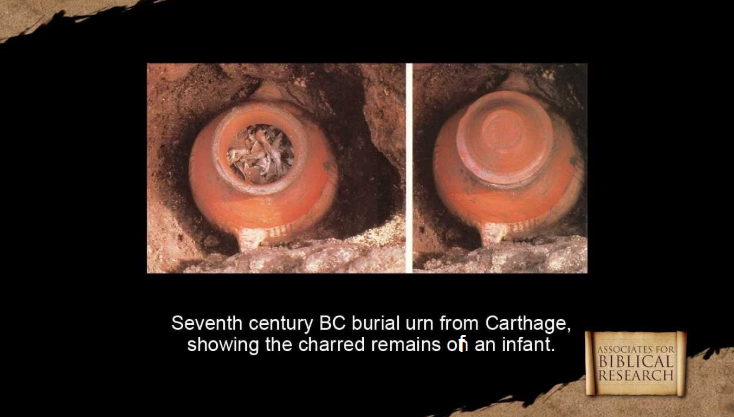
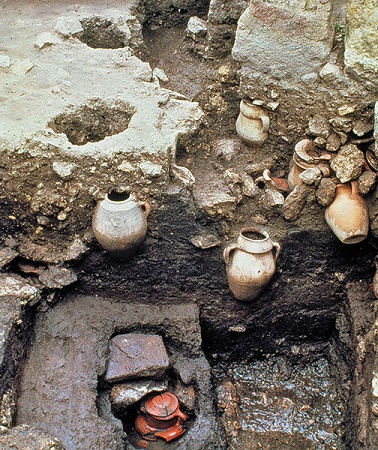
Introduction
I was born in Alice Springs, the centre of the 85% of the Australian mainland that is arid or semiarid, and grew up in the Tanami Desert with Aborigines, some of whom were seeing white people for the first time. They had tribal patterns of behaviour with tribal wars, clan wars, revengeful ‘payback’ escalating to death, general violence, witchcraft, fears, and vigorous defence of their tribal territory for their own sheer survival in desert country. It was ‘kill or be killed’ in this desert life of minimal and undependable water supply, along with having no tools for gardens or water, only for killing. This background makes the first eleven books of the Old Testament more understandable for me.
With the Christian-based sensitivities of 21st century Western settled, secure, safe, stable, suburban and academic life the violent parts of the Bible do not make sense, such as the ‘eye for an eye’ being a stature of limitations, you can take no more than an eye for an eye or a tooth for a tooth, and that was the end of the matter, no escalation of payback to the death of one contender. Escalating payback also explains why the judges in the book of that name were military heroes, not someone trained in law; the military hero was the only person who could give a judgment against you and survive, firstly because he was the military hero so you should be careful taking him on, and secondly because he had the tribal warriors behind him - because he was their military hero.
But this background does not explain the instructions to the Israelites, when going into the Promised Land, to kill everyone there, “you must utterly destroy them. Make no covenant with them, and show them no mercy”. (Deuteronomy 7:2) How does this fit with a creator God of love and mercy? How does this fit with the words of Jesus, “Love your enemies”?
The explanation given here is that these biblical instructions were aimed at wiping out the abominable practice of child sacrifice in the worship of the gods, and that atheists (Lucretius) agree with God that human sacrifice, especially child sacrifice, is the worst thing that people do in the name of their religion. Israel did not wipe out or expel these people, instead they took on their gods and behaviours and, as prophesied, became worse than the previous people, to the extent of repeated returns to child sacrifice which, as Israel’s history shows, is an unrecoverable state. The result was the wipeout of Israel itself, first the northern ten tribes ‘Israel’ by the Assyrians, then the southern kingdom, ‘Judah’, by Babylon, with only a remnant of a remnant returning from exile.
1. Setting up a Theocracy : The formation and purpose of ‘Israel’
The Bible presents a history from the beginning of created human life, of the violence and other effects of faulty decisions, and attempts to give humans fresh starts.
1.1. Why a theocracy?
Plan a. Adam and Eve made wrong choices, as did their descendants in spreading violence over the face of the earth to such an extent that
Plan b. because of this human violence God used a flood to wipe out all except one family, led by Noah, who made a mess almost straightaway.
Plan c. God’s next choice was to set up a theocracy; Israel, whose rôle was to show the world what a better life we could all have if we lived within the telos of creation, as the creator God intended human life to be. Israel was to have God as their king, with a priestly class to teach the people and help the leaders to keep straying individuals from going too far, and to help them return to the right way. And to severely punish those who would not. The word ‘Israel’ names one who struggles with God, the long story into the present, and this article describes the failures of this struggle.
Plan d. Jesus, the Son of God Himself.
1.2. Abraham and Isaac
I imagine God saying – “Look at that! These humans really will do this sort of thing – sacrifice their children to – to what?! For what?! Even this fellow Abraham, whom I thought was a pretty decent, sensible sort of guy, has not questioned the order, as he did about Sodom and Gomorrah!” Genesis 18:16-38
The ‘sacrifice of Isaac’ (Genesis 22:1-19) was to teach Abraham, and his descendants, that this was what they were NOT to do; that God would provide the sacrifices, as in that episode; next, in the Temple sacrificial system, and eventually with Plan d, his own Son.
1.3. Abraham shown the Promised Land, sent away
Abraham was chosen to found a nation with the intention, as stated above, that this nation, by living properly as intended by the creator God, would demonstrate to everyone around that this really was the best way for individuals, communities, and nations to live.
Abraham was shown the Promised Land - Genesis 15:16 "And they shall come back here in the fourth generation; for the iniquity of the Amorites is not yet complete." When complete, the iniquity of the people in that region was child sacrifice in the worship of the gods...
The Israelites went into Egypt, there into slavery, from which Moses led them out in the great Exodus, followed by a period of struggle in the Wilderness.
1.4. To the Promised Land, “show them no mercy”?
When they were finally about to enter their Promised Land, the Israelites were told to do this by wiping out everyone in the Promised Land, to “show them no mercy”. It was not because of sin, everyone does that. It was not just because of worship of idols as everyone outside Israel, and quite a few inside Israel, did. The Golden Calves idolatry (Exodus 32), was a recoverable lapse. “Show them no mercy” was because of child sacrifice, the worst of the “abominations” that these people did in the worship of their gods. Israel itself later showed that there is no way back when a religion / culture reaches that extreme of child sacrifice in the worship of their gods.
Leviticus 18.21 You shall not give any of your offspring to sacrifice them [or: to pass them over] to Molech, and so profane the name of your God. I am the LORD. … 24 Do not defile yourselves in any of these ways, for it is by all these practices that the nations I am casting out before you had defiled themselves.
"Molech", sometimes "Moloch", was a god to which the sacrifice was child sacrifice, and in places this name is used as shorthand for the whole practice of 'child sacrifice'.
Leviticus 18.26 ... but you shall keep my statutes and my ordinances and commit none of these abominations, either the citizen or the alien who resides among you, 27 [for the inhabitants of the land, who were before you, committed all of these abominations, and the land became defiled], 28 otherwise the land will vomit you out for defiling it, as it vomited out the nation that was before you. 29 For whoever commits any of these abominations shall be cut off from their people. 30So keep my charge not to commit any of these abominations that were done before you, and not to defile yourselves by them. I am the LORD your God.
Leviticus 20:1 The LORD spoke to Moses, saying: 2 Speak to all the congregation of the people of Israel and say to them: Any of the people of Israel, or of the aliens who reside in Israel, who give [sacrifice] any of their offspring to Molech shall be put to death; the people of the land shall stone them to death. 3 I myself will set my face against them, and will cut them off from the people; because they have given of [sacrificed] their offspring to Molech, defiling my sanctuary and profaning my holy name. 4 And if the people of the land should ever close their eyes to them, when they give of [sacrifice] their offspring to Molech and do not put them to death, 5 I myself will set my face against them and against their family, and will cut them off from among their people, them and all who follow them in prostituting themselves to Molech.
Leviticus 20:22 You shall keep all my statutes and all my ordinances, and observe them, so that the land to which I bring you to settle in may not vomit you out. 23 You shall not follow the practices of the nation that I am driving out before you. Because they did all these things, I abhorred them.
Deuteronomy 7:1 When the LORD your God brings you into the land which you are about to enter and occupy, and he clears away many nations before you – the Hittites, the Gergashites, the Amorites, the Canaanites, the Perizzites, the Hivites and the Jebusites, seven nations mightier and more numerous than you – 2 and when the LORD your God gives them over to you and you defeat them, then you must utterly destroy them. Make no covenant with them, and show them no mercy. [...] 5 But this is how you must deal with them: break down their altars, smash their pillars, hew down their sacred poles, and burn their idols with fire. 6 For you are a people holy to the LORD your God; the LORD your God has chosen you out of all the peoples on the earth to be his people, his treasured possession.
Deuteronomy 7:16 You shall devour all the peoples that the LORD your God is giving over to you, showing them no pity; you shall not serve their gods, for that would be a snare to you. It was made clear to the people of Israel that the order to “show them no mercy” was not because the people of Israel were themselves especially good or holy or better than anyone else, as they had shown in their time in the desert,
Deuteronomy 9:4 When the Lord your God thrusts them out before you, do not say to yourself, ‘It is because of my righteousness that the Lord has brought me in to occupy this land’: it is rather because of the wickedness of these nations that the Lord is dispossessing them before you. 5 It is not because of your righteousness or the uprightness of your heart that you are going in to occupy their land; but because of the wickedness of those nations that the Lord your God is dispossessing them before you, in order to fulfil the promise that the Lord made on oath to your ancestors, to Abraham, to Isaac, and to Jacob 6 Know then, that the Lord your God is not giving you this good land to occupy because of your righteousness, for you are a stubborn people.
God choosing Israel as his people had obligations attached:
Deuteronomy 11:26 See, I am setting before you today a blessing and a curse: 27 the blessing if you obey the commandments of the LORD your God that I am commanding you today; 28 and the curse, if you do not obey the commandments of the LORD your God, but turn from the way that I am commanding you today, to follow other gods that you have not known.
There were repeated warnings, spelling out that it was not just idolatry for which the land was being condemned. Again ‘abhorrent’ is tied to child sacrifice.
Deuteronomy 12:29 When the LORD your God has cut off before you the nations whom you are about to enter to dispossess them, when you have dispossessed them and live in their land, 30 take care that you are not ensnared into imitating them, after they have been destroyed before you: do not inquire concerning their gods, saying, ‘How did these nations worship their gods? I also want to do the same.’ 31 You must not do the same for the LORD your God, because every abhorrent thing that the LORD hates they have done for their gods. They would even burn their sons and their daughters in the fire to their gods.
‘Detestable practices’ are a recoverable situation, but are also a slippery slope to the abhorrent end stage of child sacrifice:
Deuteronomy 18:9 When you come into the land that the LORD your God is giving you, you must not learn to imitate the abhorrent practices of those nations. 10 No one shall be found among you who makes a son or daughter pass through fire, or who practises divination, or is a soothsayer, or an augur, or a sorcerer, 11 or one who casts spells, or who consults ghosts or spirits, or who seeks oracles from the dead. 12 For whoever does these things is abhorrent to the LORD; it is because of such abhorrent practices that the LORD your God is driving them out before you.
“Pass through fire” indicates that the sacrificed person was burned to death, rather than killed and then burnt/cooked (before being eaten - see below).
‘Abhorrent’ practices were the warrant for clearing the land of those people, as the history of Israel itself eventually shows that there is no way back once a people descend to that depth in their religious practice :
Deuteronomy 20:16 But as for the towns of these peoples that the LORD your God is giving you as an inheritance, you must not let anything that breathes remain alive. 17 You shall annihilate them – the Hittites and the Amorites, the Canaanites and the Perizzites, the Hivites and the Jebusites – just as the LORD your God has commanded, 18 so that they may not teach you to do all the abhorrent things that they do for their gods, and you thus sin against the LORD your God.
1.5. Why not intermarry?
The Israelites were banned from intermarrying with the people already in the Promised Land because they could and would thus be led astray to do the same abhorrent things:
Exodus 34:16 And you will take wives from among their daughters for your sons, and their daughters who prostitute themselves to their gods will make your sons also prostitute themselves to their gods.
Deuteronomy 7: 3 Do not intermarry with them, giving your daughters to their sons or taking their daughters for your sons 4 for that would turn away your children from following me, to serve other gods. Then the anger of the LORD would be kindled against you, and he would destroy you quickly.
Solomon’s marrying foreign wives was the cause of their downfall, as will be seen below.
1.6. Israel’s Choice: Monotheism or polytheism
Deuteronomy 28:1-14 lists the blessings of Israel as a nation (not as an individual prosperity gospel) following the commands of the Lord their God.
Deuteronomy 28:15-68 is a far longer list of retribution if Israel as a nation disobeyed God’s commands. There would always be individuals who would disobey God’s commands, but the assumption was that the leaders of Israel would correct the situation. This story later shows what happened when it was the leader himself, King Solomon, who led the nation astray.
On the edge of entering the Promised Land, Joshua (24:14-15) gave the people of Israel a choice, either to serve the gods of their fathers [the region from which Abraham came], put those gods away [their tokens had been carried with them - right up to then! This began at least with Rachel, Genesis 31:19ff] or to serve the gods of the Amorites, in whose land you are living; but as for me and my household, we will serve the LORD.’ (pointing back to Genesis 15:16) or to serve the God who had rescued them from slavery and had cared for them thus far.
Then the people answered …18 the LORD drove out before us all the peoples, the Amorites who lived in the land. Therefore we also will serve the LORD, for he is our God.’ (Pointing to Judges 11:19-24)
Of their following of God; Joshua 24:31 “Israel served the LORD all the days of Joshua, and all the days of the elders who outlived Joshua and had known all the work that the LORD did for Israel.”
Although the Amorites are not described as sacrificing children, they seem to be representative of the whole culture in the Promised Land which did that.
1.7. In the Promised Land, Joshua and Judges
Israel stumbled around for years in chaotic wars, and failed to take over the Promised Land. They failed to follow the instructions to “show them no mercy”, forgot the order to wipe out or to push out the inhabitants in the land. They also intermarried with the locals and came to worship the gods of that area. They also forgot the order "And you shall not give any of your offspring, to sacrifice them [to pass them over] to Moloch, and so profane the name of your God: I am the LORD." (Lev.18:21), with terrible consequences:
Judges 2:2b ‘But you have not obeyed my command. See what you have done! 3 So now I say, I will not drive them out before you; but they shall become adversaries to you, and their gods shall be a snare to you.’
Judges 2:10b-12 “another generation grew up after them, who did not know the LORD or the work that he had done for Israel. 11 Then the Israelites did what was evil in the sight of the LORD and worshipped the Baals; 12 and they abandoned the LORD, the God of their ancestors who had brought them out of the land of Egypt; they followed other gods, from among the gods of the inhabitants who were all around them, and they bowed down to them and provoked the LORD to anger.”
Judges 10:6 to 11:33 is the story of the Amorites who had been wiped out, their neighbours the Ammonites had also descended to the worship of Chemosh, to child sacrifice, and were wiped out.
1.8. Kill all - all the women and all the children!
G. K. Chesterton said that soldiers do what they do, not because of what is in front of them but because of what is behind them. Then what of being told to wipe out an entire population of people who are not attacking the Israelites, but to do it for an abstract religious principle? How does that fit a warrior code?
To kill women and children was, is, outside warrior culture, as expressed by a military fellow (my wording may be less direct, more polite, than his unprintable response) at the thought of being told to kill all the children in front of him. What degree of ‘Post-Traumatic Stress Disorder’ would this produce in the soldiers?
A second problem with a normal warrior code is - how could they reconcile – ‘We are killing all of you, including all of your women, and all of your children for our God, because you sacrifice some of your children to your gods’?
Perhaps it is not surprising that they could not continue this manner of ‘warfare’.
2. Israel’s demand for Royalty
Judges gives a history of repeated cycles of :
-Worshipping their God
-Taking to the gods around them
-Being attacked and oppressed.
-Crying out to their God to rescue them.
-God raising up a judge, a military hero, to rescue them from their oppressors
-Returning to proper worship of their God.
The military heroes became judges because, as I saw in my mission upbringing, in a tribal setting the military hero is the only person who can give a judgement against you and survive, the only person on whom you will not consider revenge [‘payback’], firstly because he is the tribe’s military hero, so you would be brave and stupid to take him on, and secondly because he has the warriors behind him because he is their military hero.
I also saw that the ‘eye for an eye’ was actually a statute of limitation, that you were not to take more than an eye for an eye, and that that was the end of the affair. However, this had become a system of increasing revenge both ways (called ‘payback’) escalating to the death of one party. This escalating payback system resulted in at least 25% of Aboriginal deaths in the early written records. An ‘eye for an eye’ applied only to offenders within your own tribe. Offenders from outside the tribe? No problem, you got together and went and killed them. No more trouble!
After several such cycles the Israelites asked for a king, not to keep them on the straight and narrow but to have a standing army to protect them from being punished for worshipping other gods. This is why God said to Samuel:
‘Listen to the voice of the people in all that they say to you; for they have not rejected you, but they have rejected Me from being king over them.’ … ‘It is not you that they are rejecting, it is Me.’ 1 Samuel 8:4-9.
Samuel’s reaction to the people of Israel going against his advice is a model for dealing with controversy, a model not always followed in Christian history;
1 Samuel 12:23 ‘Moreover as for me, far be it from me that I should sin against the Lord by ceasing to pray for you, and I will instruct you in the good and the right way.’
3. Who set up Israel for failure? SOLOMON!
In the setting up of Israel as a theocracy it was assumed that individuals would go off the rails and require the leaders to restore order. So what happens when it is the leader, the very king, who leads the nation astray? That was Solomon in all his glory and wisdom!?!
Israel made its biggest splash on the international scene with Solomon their ‘wisest’ ruler, but the wisdom of hundreds of wives and concubines (taking on 1,300 mothers-in-law!) might be questioned, especially in view of its consequences. Solomon took Israel down with what he set in motion, and is blamed for it in Nehemiah 13:23f, as you will see.
1 Kings 11 is the hinge of the history of Israel. Israel had been rising in importance to Solomon’s time, but in his old age Solomon set up shrines to his foreign wives’ gods. From there it was downhill to wipeout, with only a remnant going into exile, and a remnant of the remnant returning.
1 Kings 11: 1 King Solomon loved many foreign women along with the daughter of Pharaoh: Moabite, Ammonite, Edomite, Sidonian, and Hittite women, 2 from the nations concerning which the LORD had said to the Israelites, ‘You shall not enter into marriage with them, neither shall they with you, for they will surely incline your heart to follow their gods’, Solomon clung to these in love, 3 and his wives turned away his heart. 4 For when Solomon was old, his wives turned away his heart after other gods, and his heart was not true to the LORD his God, as was the heart of his father David. 5 For Solomon followed Astarte the goddess of the Sidonians, and Milcom the abomination of the Ammonites. 6 So Solomon did what was evil in the sight of the LORD, and did not completely follow the LORD, as his father David had done. 7 Then Solomon built a high place for Chemosh the abomination of Moab, and for Molech the abomination of the Ammonites, on the mountain east of Jerusalem. 8 He did the same for all his foreign wives, who offered incense and sacrificed to their gods.
The names of the gods are important.
Molech (“Milcom”) was a god to whom the only sacrifice was child sacrifice.
Chemosh was a god to whom, increasingly, sacrifice was child sacrifice.
‘Abomination’ refers to the practice of child sacrifice, whereas ‘despicable practices’ refers to things done in the worship of foreign gods but were recoverable situations.
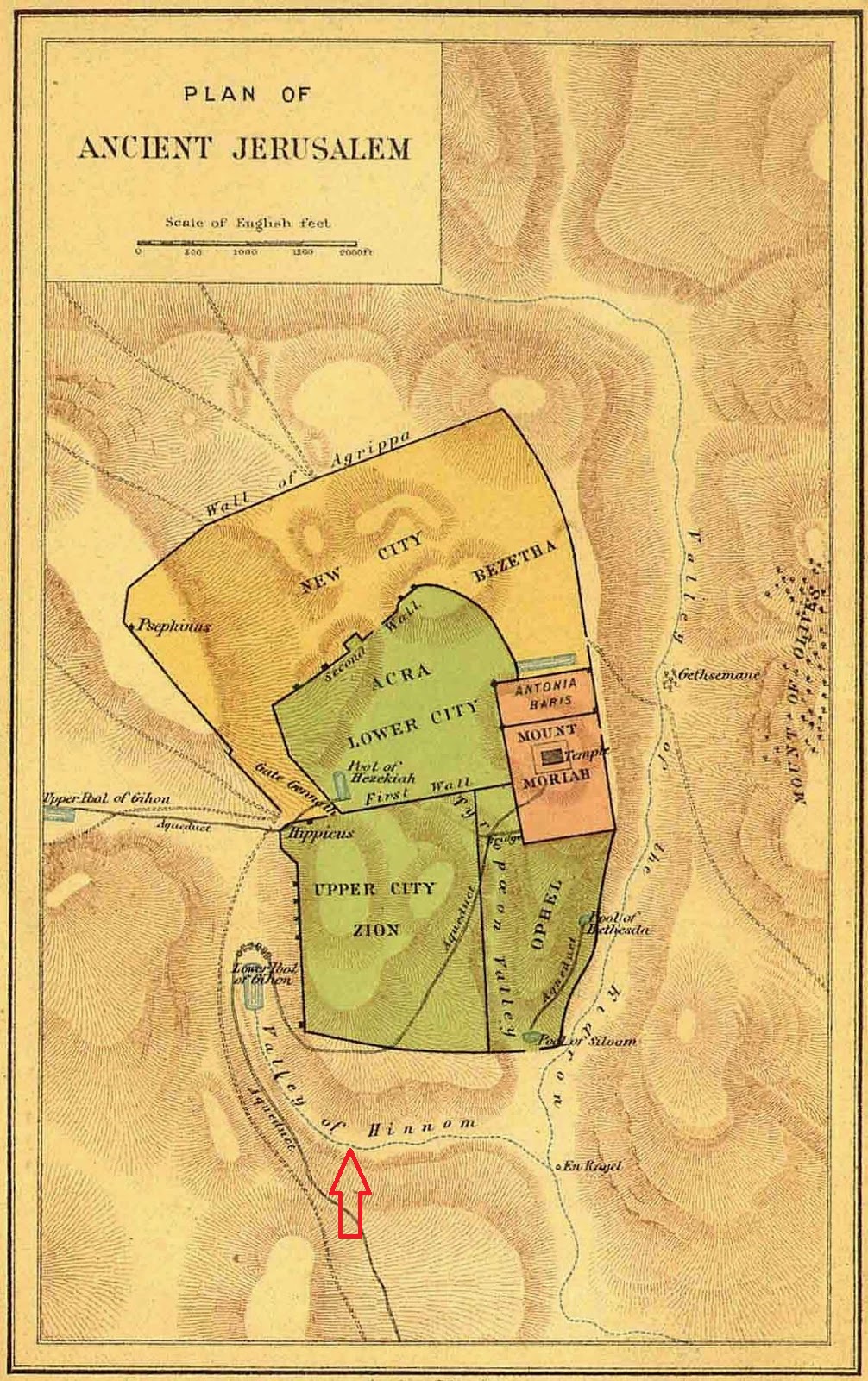
Here, at the height of the glory of Israel, by the person who built the temple to the LORD their God, are the seeds of destruction sown. Major shrines were later set up in the Valley of Ben Hinnom, on one side of the hill on which Jerusalem stood, and this would be central to their self-destructive child-sacrificing actions.
The Lord told Solomon that this would lead to the break-up of the kingdom (1 Kings 11:9-13) - but not in Solomon’s lifetime - ‘for the sake of your father David’:
11.9 Then the LORD was angry with Solomon, because his heart had turned away from the LORD, the God of Israel, who had appeared to him twice, 10 and had commanded him concerning the matter, that he should not follow other gods, but he did not observe what the LORD commanded. 11 Therefore the LORD said to Solomon, ‘Since this has been your mind and you have not kept my covenant and my statutes that I have commanded you, I will surely tear the kingdom from you and give it to your servant. 12 Yet for the sake of your father David I will not do it in your lifetime; I will tear it out of the hand of your son. 13 I will not, however, tear away the entire kingdom; I will give one tribe to your son, for the sake of my servant David and for the sake of Jerusalem, which I have chosen.’
Unlike his father David, Solomon never took notice of warnings, even from God.
The prophet Ahijah saw the implications of Solomon’s actions:
1 Kings 11:29 About that time, when Jeroboam was leaving Jerusalem, the prophet Ahijah the Shilonite found him on the road. Ahijah had clothed himself with a new garment. The two of them were alone in the open country 30 when Ahijah laid hold of the new garment he was wearing and tore it into twelve pieces. 31 He then said to Jeroboam: ‘Take for yourself ten pieces; for thus says the LORD, the God of Israel, ‘See, I am about to tear the kingdom from the hand of Solomon, and will give you ten tribes. 32 One tribe [Judah] will remain his, for the sake of my servant David and for the sake of Jerusalem, the city that I have chosen out of all the tribes of Israel. 33 This is because he [Solomon] has forsaken me, worshipped Astarte the goddess of the Sidonians, Chemosh the god of Moab, and Milcom [=Molech] the god of the Amonnites, and has not walked in my ways, doing what is right in my sight and keeping my statutes and my ordinances, as his father David did. … 39 For this reason I will punish the descendants of David, but not forever.
Chronicles is more sympathetic to David and Solomon than the books of Kings; it does not record the incident of David and Bathsheba, but it does record the LORD’s appearance to Solomon after the dedication of the temple, and the warning given:
2 Chronicles 7:19 "But if you turn aside and forsake my statutes and my commandments that I have set before you, and go and serve other gods and worship them, 20 then I will pluck you up from the land that I have given you, and this house, which I have consecrated for my name, I will cast out of my sight, and will make it a proverb and a byword among all peoples. 21 And regarding this house, now exalted, everyone passing by will be astonished, and say, ‘Why has the LORD done such a thing to this land and to this house?" 22 Then they will say, ‘Because they abandoned the LORD the God of their ancestors who brought them out of the land of Egypt, and they adopted other gods, and worshipped them and served them; therefore he has brought all this calamity upon them.’
In spite of recording this warning to Solomon, Chronicles does not record his setting up of shrines to his wives’ gods and his worshipping of these gods. There was no child sacrifice in Solomon’s time, but the system had been set up for the Valley of Ben Hinnom with its Topheth and its abominable place for child sacrifice in Israel’s history.
The Valley of Ben-Hinnom (the centre of Israel's child sacrifices) comes back with a bite eleven times in the words of Jesus, which bite is lost when the change of name to Gehenna is translated as ‘hell’ (implying punishment in the next life, not in this) with the return from exile. As will be shown further along.
4. The Split of Israel
When Solomon died his son Rehoboam took over, but continued his father’s burdensome tax system until the people revolted. Jeroboam (also son of Solomon) was elected king of the revolting northern ten tribes, which northern kingdom became known as “Israel”, Rehoboam had the southern kingdom, which consisted of the tribes of Judah and Benjamin (which combined) (and some Levites), was referred as “Judah”. From this came the change of name from ‘Israelites’ to ‘Jews’ (from 'Judah') when ‘Israel’ was wiped out.
Each kingdom decayed in its own way and timescale to much the same end. This decay and destruction is prophesied in Hosea chapter 1:2 :
"When the LORD first spoke through Hosea, the LORD said to Hosea, ‘Go take for yourself a wife of whoredom and have children of whoredom, for the land commits great whoredom by forsaking the LORD.’ 3So he went and took Gomer daughter of Diblaim and she conceived and bore him a son. 4And the LORD said to him, ‘Name him Jezreel; for in a little while I will punish the house of Jehu for the blood of Jezreel, and I will put an end to the kingdom of the House of Israel. 5On that day I will break the bow of Israel in the valley of Jezreel’. 6She conceived again and bore a daughter. Then the LORD said to him, ‘Name her Loruhamah, for I will no longer have pity on the house of Israel or forgive them. 7But I will have pity on the house of Judah, and I will save them by the LORD their God; I will not save them by bow, or by war, or by horseback, or by horsemen.’ 10Yet the number of the people of Israel shall be like the sand of the sea, which can neither be measured nor numbered; and in the place where it was said of them, ‘You are not my people’, it shall be said to them, ‘Children of the living God.’ 11The people of Judah and the people of Israel shall be gathered together, and they shall appoint for themselves one head; and they shall take possession of the land, for great shall be the day of Jezreel."
4.1. The Northern Kingdom - “Israel”
The Northern kingdom decayed the fastest and was wiped out first. Their first king was Jeroboam, son of Solomon, (1 Kings 12:31-33, 13:28ff.), who :
1. broke the unity of God’s people physically (v 2-26) and spiritually (v 26-27)
2. changed the religious symbols of Israel, setting up two golden calves to keep people from worshipping in Jerusalem, by making idols to be national gods.
3. changed the religious worship centre from Jerusalem to Dan and Bethel.
4. changed the priesthood by making priests of anyone who wanted the job. With this almost all the priests and Levites left for the south, leaving no one to teach the people or the king, so that none of the kings of the Northern kingdom turned his heart and kingdom back to God.
5. changed the religious calendar, setting up his own holy days, and his own sacrificial system (1 Kings 13:33-34).
6. gave himself the role of priest by burning incense on the altar in Bethel.
This is not a heresy of the old religion but a new religion, which may be why there was no clean-up by any of the northern kings, there was none of the old priests and belief system to restore them from their new religions.
Jeroboam became the evil yardstick for measuring his successors (1 Kings 15:26, 34; 16:2, 19, 26, 31; 22:52 etc.
Ahab and Jezebel, 874-853B.C., reigned 22 years, (1 Kings 16:28 – 22:40; 2 Chr 18:1-34): Ahab built a temple to Baal, which was almost as bad as royalty did.
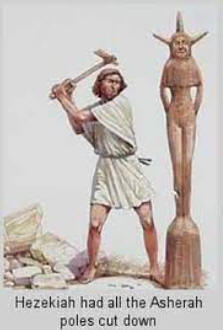
1 Kings 16:32: ‘He [Ahab] erected an altar for Baal in the house of Baal which he built in Samaria. 33 Ahab also made a sacred pole [Asherah]. Ahab did more to provoke the anger of God that all the kings of Israel who were before him. 34 In his day Hiel of Bethel built Jericho: he laid its foundation at the cost of (1 My list modified a little from Wiseman, Donald J., 1 and 2 Kings: An Introduction and Commentary, IVP Academic, Downers Grove, Ill., 1993, reprinted 2008, p. 155) Abram his firstborn, and set up its gates at the cost of his youngest son Segub, according to the word of the LORD, which he spoke by Joshua son of Nun.’
In this context ‘at the cost of his son’ indicates child sacrifice for that project.
2 Kings 3:26 When the king of Moab saw that the battle had gone against him, he took with him seven hundred swordsmen to break through, opposite the king of Edom; but they could not. 27 Then he took his firstborn son who was to succeed him, and offered him as a burnt-offering on the wall.

4.1.1. Wipe-out of “Israel”, the northern 10 tribes
Rather than projecting their own characteristics on to the gods, these people took on the characteristics of the gods that they chose to worship, which led first to the destruction of the northern ten tribes of Israel. We are not given as much detail about the kings and the misbehaviours of the northern kingdom, until the summary at their exile:
2 Kings 17:5-20.
Time Scale - The northern kingdom of ten tribes lasted around 210 years, with 19 kings and 9 dynasties, each new dynasty arising by murdering the previous king, with no good king who had set about reforming or restoring their worship.
To Exile - In 722B.C. the northern kingdom, 'Israel', was defeated by Assyria, the population was deported to various places listed in 2 Kings 17:6 and 18:11. “The Assyrian came down like a wolf on the fold, and his cohorts were gleaming in purple and gold…”
The destruction of the northern kingdom, “Israel”, 2 Kings 17:7-23, was because the kings of the northern kingdom brought in worse practices than the peoples there, rather that correcting the practices of the people of Israel.
2 Kings 17:7 “This occurred because the people of Israel had sinned against the LORD their God, who had brought them up out of the land of Egypt from under the hand of Pharaoh king of Egypt. They had worshipped other gods, 8and walked in the customs of the nations whom the LORD drove out before the people of Israel, and in the customs that the kings of Israel had introduced.”... 15b They went after false idols and became false, they followed the nations that were around them, concerning whom the LORD had commanded them that they should not do as they did. 16 They rejected all the commandments of the LORD their God and made for themselves cast images of two calves; they made a sacred pole, worshipped all the host of heaven, and served Baal. 17 They made their sons and their daughters pass through fire; they used divination and augury; and they sold themselves to do evil in the eyes of the LORD, provoking him to anger.
Child sacrifice is the extreme deformity of their (and any) religion.
18Therefore the Lord was very angry with Israel and removed them out of his sight; none was left but the tribe of Judah alone. 19Judah also did not keep the commandments of the LORD their God but walked in the customs that Israel (the northern 10 tribes) had introduced. [emphasis added] 20The LORD rejected all the descendants of Israel; he punished them and gave them into the hand of plunderers, until he had banished them from his presence.
4.1.2. The northern kingdom failed, even in exile, so no return.
The people of the Northern Kingdom were removed into exile (732-720B.C., 2 Kings 17-18:12), and the King of Assyria repopulated the land of the Northern Kingdom from the rest of his empire. When these imported peoples got into trouble the Assyrian king had them taught how to worship the LORD of that land, 2 Kings 17:28. But the priests of the north were self-appointed, only half-heartedly learned their lessons, and went on worshipping the gods of the countries from which they came.
31bThe Sepharvites burned their children in the fire to Adrammelech and Anammelech, the gods of Sepharvaim. [“melech” = Molech] 32They also worshipped the LORD and appointed from among themselves all sorts of people as priests of the high places, who sacrificed for them in the shrines of the high places. 33 So they worshipped the LORD, but they also served their own gods, after the manner of the nations from among whom they had been carried away. 41So these nations worshipped the LORD, but also served their carved images; to this day their children and their children’s children continue to do as their ancestors did." (2 Kings 17:29-41.)
Because of these failures to learn any lesson from their experience, even continuing to sacrifice their children to foreign gods on the same day as worshipping the God of Israel, no one from the northern kingdom returned from exile, hence the ‘ten lost tribes of Israel’.
4.2. The Southern Kingdom: Judah, Judaea, ‘Jews’
The Southern Kingdom consisted of the tribes of Judah, the half-tribe of Benjamin (which combined), and some Levites, but Solomon’s son, Rehoboam led them astray at the beginning (1 Kings 11:42-12:24; 14:21-31; 2 Chronicles 9:31-12:16).
Rehoboam (1 Kings 14:21) was 41 when he began his reign of 17 years.
1 Kings 14:22 Judah did what was evil in the sight of the LORD; they provoked him to jealousy with their sins that they committed, more than all that their ancestors had done. 23For they also built for themselves high places, pillars, and sacred poles on every high hill and under every green tree; 24there were also male temple prostitutes in the land. They committed all the abominations of the nations that the LORD drove out before the people of Israel.
Rehoboam followed his father’s bad example, not just in taxation.
Time Scale : The southern kingdom, “Judah”, lasted 350 years, consisted of one dynasty, the house of David,
had some good kings, but the good that they did was always undone; and worse would follow.
The second king, Abijam (1 Kings 14:31-15:8; 2 Chronicles 13:1-22), son of Rehoboam, committed all the sins of his father.
After two bad kings were two good kings,
Asa (1 Kings 15:8-24; 2 Chronicles 13:1-22) and Jehoshaphat (1 Kings 22:1-50; 2 Chronicles 14:1 – 16:14), who removed many of the symbols of other religions, but not the “high places”. Jehoshaphat did get rid of the remnants of male temple prostitutes.
Next came three bad monarchs - Jehoram (2 Kings 8:16-24; 2 Chronicles 21:1-20), Ahaziah (2 Kings 8:24 – 9:29; 2 Chronicles 22:1-9), and Queen Athaliah (2 Kings 11:1-20; 2 Chronicles 22:1 – 23:21), who followed the bad example of Ahab.
Then four good kings who did what was right, but not completely:
Jehoash (Joash) (2 Kings 11:1 – 12:21; 2 Chronicles 22:10 – 24:27) did what was right in the eyes of the LORD, but did not destroy the ‘high places’ where people continued to sacrifice and worship, even though the priests, people, and army destroyed the temple etc. of Baal. Joash repaired the Temple (2 Kings 12:1-16), and was killed by his servants (2 Kings 12:19-21).
Amaziah (2 Kings 14:1-20; 2 Chronicles 25:1-28),
Azariah (Uzziah) (2 Kings 15:1-7; 2 Chronicles 26:1-23), and
Jotham (2 Kings 15:32-38; 2 Chronicles 26:1-23) did what was right, but they did not remove the “high places”.
Next came one of the worst kings - Ahaz, son of Jotham (2 Kings 16:1-20; 2 Chronicles 28:1-27) did not do what was right, but walked in the way of the kings of Israel. The first recorded child sacrifice in Judah is by none other than the king himself. This section also attaches ‘abominable practices’ to child sacrifice.
2 Kings 16:2 Ahaz was twenty years old when he began to reign; he reigned for sixteen years in Jerusalem. He did not do what was right in the sight of the LORD his God, as his ancestor David had done, 3but he walked in the way of the kings of Israel. He even made his son pass through fire according to the abominable practices of the nations whom the LORD drove out before the people of Israel. 4He sacrificed and made offerings on the high places, on the hills and under every green tree.

This story of Ahaz is repeated in 2 Chronicles 28:1-4, with the added details that he burned sons, not son, and that it was in the Valley of the son of Hinnom. When the king is involved in child sacrifice in the worship of the gods then it becomes a huge social, cultural, political, as well as religious event.
Ahaz also replaced the LORD’s altar in the Jerusalem Temple with one modelled on an altar in Damascus (2 Kings 16:10-16).
Ahaz was followed by a good king, Hezekiah son of Ahaz, (2 Kings 18:1 – 20:21; 2 Chronicles 29:1 – 32:33) did what was right, removed the “high places”, cut down many sacred sites. By the sixth year of his reign Assyria had overrun the northern kingdom. Hezekiah bought off the Assyrians, consulted with Isaiah, prayed; Sennacherib was defeated by the angel of the LORD in the night. (2 Kings 19:35f).
The worst of their kings followed: Manasseh, son of Hezekiah (2 Kings 21:1-18; 2 Chronicles 33:1-20). The southern kingdom did not learn from the events in the north but worsened, even putting idols inside the temple of the LORD their God.
2 Kings 21:1 Manasseh was twelve years old when he began to reign, he reigned for fifty-five years in Jerusalem. … 2 He did what was evil in the sight of the LORD, following the abominable practices of the nations that the LORD drove out before the people of Israel. 3 For he rebuilt the high places that his father Hezekiah had destroyed; he erected altars for Baal, made a sacred pole, as King Ahab of Israel had done, worshipped all the host of heaven, and served them. 4 He built altars in the house of the LORD, of which the LORD had said, ‘In Jerusalem I will put my Name.’ 5 He built altars for all the host of heaven in the two courts of the house of the LORD. 6 He made his son pass through fire; he practised soothsaying and augury, and dealt with mediums and with wizards. He did much evil in the sight of the LORD, provoking him to anger. 9bManasseh misled them to do more evil than the nations had done that the LORD destroyed before the people of Israel. … 16Moreover, Manasseh shed very much innocent blood, until he had filled Jerusalem from one end to another, besides the sin that he caused Judah to sin so that they did what was evil in the sight of the LORD. (as prophesied)
2 Chronicles 33 again adds more details, such as that Manasseh burned his son in the Valley of the son of Hinnom.
7The carved image of the idol that he had made he set in the house of God, of which God said to David and to his son Solomon, ‘In this house, and in Jerusalem, which I have chosen out of all the tribes of Israel, I will put my Name for ever. 8I will never again remove the feet of Israel from the land that I appointed to your ancestors, if only they will be careful to do all that I have commanded them, all the laws, the statutes, and the ordinances given through
Moses.’ 9Manasseh misled Judah and the inhabitants of Jerusalem, so that they did more evil than the nations whom the LORD had destroyed before the people of Israel.’ (emphasis on what happened that was prophesied).
Kings does not record the reform of Manasseh of 2 Chronicles 33:10-17.
Amon, son of Manasseh did what was evil (2 Kings 21:19-26; 2 Chronicles 33:21-25).
Following the worst of their kings came the best -
Josiah, son of Amon (2 Kings 22:1 – 23:30; 2 Chronicles 34:1 – 35:27) found the book of the Law. 2 Kings 23:1-25 describes all the reforms of Josiah, worth reading to see how far the Israelites had sunk, and includes:
10[Josiah] defiled Topheth (sacrificial site) , which was in the Valley of Ben-Hinnom, so that no one would make a son or a daughter pass through fire as an offering to Molech. ... 13The king defiled the high places that were east of Jerusalem, to the south of the Hill of Destruction, which King Solomon of Israel had built for Astarte the abomination of the Sidonians, for Chemosh the abomination of Moab, and for Milcom [Molech] the abomination of the Ammonites. …
Solomon’s altars to these gods of ‘abomination’ had lasted for over 300 years!
25Before him [Josiah] there was no king like him, who turned to the LORD with all his heart, with all his soul, and with all his might, according to all the Law of Moses; nor did any like him arise after him. 26Still the LORD did not turn from the fierceness of his great wrath … because of all the provocations with which Manassah had provoked him. 27The LORD said: ‘I will remove Judah also out of my sight, as I have removed Israel; and I will reject this city I have chosen, Jerusalem, and the houses of which I said, ‘My name shall be there.’
Josiah’s reforms are also recorded by the Chronicler, again with more detail:
2 Chronicles 34 – the reforms of Josiah, who read the books of the law, and all the curses therein:
35:18The Passover had not been observed like this in Israel since the days of the prophet Samuel. vv. 22-28, the prophetess Huldah said that nevertheless, the curses would be carried out as written, but not in Josiah’s reign.
Following their best king were four kings who did what was evil,
Jehoahaz (2 Kings 23:31-33; 2 Chronicles 36:1-4),
Jehoiakim (2 Kings 23:34 – 24:5; 2 Chronicles 36:5-7),
Jehoiachin (2 Kings 24:6-16; 2 Chronicles 36:8-10), and
Zedekiah (2 Kings 24:17 – 25:30; 2 Chronicles 36:10-21), and that was the end:
Zedekiah, (2 Kings 24:18f) did evil, everyone became worse, including the leaders.
2 Chronicles 36:12[Zedekiah] did what was evil in the sight of the LORD his God. He did not humble himself before the prophet Jeremiah who spoke from the mouth of the LORD.…14All the leading priests and the people also were exceedingly unfaithful, following all the abominations of the nations; and they polluted the house of the LORD that he had consecrated in Jerusalem. 15The LORD, the God of their ancestors, sent persistently to them by his messengers, because he had compassion on his people and on his dwelling place, 16but they kept mocking the messengers of God, despising his words and scoffing at his prophets, until the wrath of the LORD against his people became so great that there was no remedy. … [The remnant of Israel went into exile to Babylon for long enough…] 21to fulfil the word of the LORD by the mouth of Jeremiah, until the land had made up for its sabbaths.
All the days that it lay desolate it kept sabbath, to fulfil seventy years. [and Leviticus 26:31-35]
4.2.1. Wipeout of Southern Kingdom, 'Judah'
The Babylonians went on a rampage and not only wiped out the southern kingdom of Judah, they wiped out child sacrifice in all of that area. [Did they do this with or without wiping out all the women and children?]
The Babylonians were punished in turn for their cruelty because they thought that they were doing this just in their own strength, not on a command of God. Nothing in this long story seems to be straightforward in moral interpretation.
The Chaldeans and Babylonians overcame Judah, the southern kingdom, and took them off into exile in three stages. The blame for the exile is again laid at Manasseh’s feet, in 2 Kings 24:3: Surely this came upon Judah at the command of the Lord, to remove them out of his sight for the sins of Manasseh, for all he had committed, 4 and also for the innocent blood that he had shed, for he filled Jerusalem with innocent blood, and the Lord was not willing to pardon. (Jer. 44:1f)
The reform of Josiah was not enough to overcome the practice and guilt of Manasseh because, with the story of repeated backsliding, something more drastic was needed to burn idolatry out of Israel, that anything else would again be temporary once they had degenerated so far as to resort to child sacrifice. Amos (2:4-5), and Jeremiah (2:23) both record that child sacrifice returned after Josiah’s reforms.
When the Babylonians came through to wipe out Judah and send the remnant into exile, they went further on the rampage, with the results :
1. that they wiped out all the high places and religious systems, so that there is no record of worshipping of foreign gods by the Israelites after that.
2. that there appears to be no child sacrifice in that region thereafter. So in punishing the Israelites for failing to do what they were told to do by ‘show them no mercy’, the Babylonians appear to have gone on to do what the Israelites were supposed to have done. [not by killing all??]
4.2.2. Remnant of remnant return from Exile
Ezra and Nehemiah give the reason for the expulsion of the foreign wives and their children by the returning men of Israel being to avoid the corrupting example of Solomon and his foreign wives noted above. (Nehemiah 13:23f) With this the Bible closes the circle for me in blaming Solomon for this complete mess.
The returning exiles also changed name of the Valley of Ben Hinnom, the site of their terrible child sacrifice, to Gehenna; see below for the significance of this in the New Testament.
5. The Prophets and Psalmist
The prophets’ consistent message is speaking against both idolatry and injustice, which they saw as connected; worshipping false gods leads to corrupt behaviour, the creational teleology of life is lost. The prophets spoke nothing new but repeated and applied the covenant curses recorded in the Pentateuch in relation to child sacrifice. “Molech” is almost spat out as the abominable god to whom children were sacrificed.
5.1. The Major Prophets
Isaiah
The prophetic view of God is of him being very active in what happens, including taking responsibility, as in God's speeches in Job, for the bad things which happen to people. Here God is talking about the role of Cyrus in his plans, Isaiah 45:7 I form light and create darkness, I make weal and create woe; I, the LORD, do all these things.
The need to act in these terrible ways is because of what the Israelites did -
Isaiah 30:33“For this burning place [or Topheth, the central sacrificial point of the Valley of Ben Hinnom] has long been prepared: truly it is made ready for the King (or Molech), its pyre made deep and wide, with fire and wood in abundance, the breath of the LORD, like a stream of sulphur, kindles it.”
This “..reveals that the word [Molech] was originally “king” (Heb. Melech) but was later [For the Septuagint, LXX, in 200B.C.] given a pejorative vocalisation (Molech) from “shame” (boshet).” [Bible Dictionary, Achtemeier, p. 694]
Isaiah 57:5 you that burn with lust among the oaks under every green tree; (i.e., idolatry) you that slaughter your children in the valleys under the clefts of the rocks. 9You journeyed to Molech with oil and multiplied your perfumes, you sent your envoys far away, and sent down even to Sheol. 11Whom did you dread and fear so that you lied and did not remember me or give me a thought? Have I not kept silent and closed my eyes, and so you do not fear me? 12I will concede your righteousness and your works, but they will not help you.
Jeremiah
The northern ten tribes, forming ‘Israel’, had been wiped out or dispersed by the Assyrians. The southern tribes forming ‘Judah’ did not learn from this and had descended to doing worse, if anything. This is the time and setting of Jeremiah. Jeremiah’s target audience knew that he was pointing to what they were doing, such as ‘abominable’ things in their worship of other gods, and that their religious practice of worshipping false gods was the ultimate sin for which this ultimate punishment was warranted.
2:23How can you say, ‘I am not defiled; I have not gone after the Baals’? Look at your way in the valley; know what you have done. .. ‘your way in the valley’ refers to their child sacrifices in the Valley of Ben Hinnom, to which place Jeremiah took the leaders of the country to explain to them what would happen as a consequence of these actions. 3:24 But from our youth the shameful thing has devoured all for which our ancestors have laboured, their flocks and their herds, their sons and their daughters. 25Let us lie down in our shame, and let our dishonour cover us, for we have sinned against the LORD our God, we and our ancestors...
Jeremiah 7 – the people of Judah had become so bad that God was going to destroy them, so angry and determined was God that he said to Jeremiah - 7:30 ‘For the people of Judah have done evil in my sight, says the LORD. They have set their abominations in the house that is called by my name, defiling it. 31 And they go on building the high place of Topheth which is in the Valley of the son of Hinnom, to burn their sons and their daughters in the fire – which I did not command nor did it come into my mind. 32Therefore the days are surely coming, says the LORD, when it will no more be called Topheth, or the valley of the son of Hinnom, but the valley of Slaughter: for they will bury in Topheth until there is no more room.
Jeremiah blames the sins of Manasseh as the cause of the exile, along with the pattern of backsliding from every stage of previous lessons taught to Israel. God no longer trusted them to reform and stay on the way of wisdom.
Jeremiah 15:4-6.
The centrepiece of Jeremiah’s story is this speech, for which Jeremiah has taken the elders and priests into the Valley of Ben Hinnom, to the site of their abominable sacrificing of their children to the gods.
Jeremiah 19:3b I am going to bring such a disaster upon this place that the ears of everyone who hears of it will tingle. 4Because the people have forsaken me, and have profaned this place by making offerings in it to other gods whom neither they nor their ancestors nor the kings of Judah have known, and because they have filled this place with the blood of the innocent, 5and gone on building the high places of Baal to burn their children in the fire as burnt offerings to Baal, which I did not command or decree, nor did it enter my mind; 6the days are surely coming, says the LORD, when this place shall no more be called Topheth, or the valley of the son of Hinnom, but the valley of Slaughter..... 11b In Topheth [at the destruction that I shall bring on] they shall bury until there is no more room to bury. 12Thus will I do to this place, says the Lord, and to its inhabitants, making this city like Topheth. 13And the houses of Jerusalem and the houses of the kings of Judah shall be defiled like the place of Topheth – all the houses upon whose roofs offerings have been made to the whole host of heaven, and libations have been poured out to the gods. 14When Jeremiah came from Topheth, where the Lord had sent him to prophesy, he stood in the court of the Lord’s house and said to all the people: 15Thus says the Lord of hosts, the God of Israel: I am now bringing upon this city and upon all its towns the disaster that I have pronounced against it, because they have stiffened their necks, refusing to hear My words.
Repeated in Jeremiah 32:30, as Jerusalem was under siege …32:34They set up their abominations in the house that bears my Name and defiled it. 35They built the high places of Baal in the Valley of the son of Hinnom to offer up their sons and daughters to Molech, though I did not command them, nor did it enter my mind that they should do this abomination, causing Judah to sin.
Jeremiah 49.1… ‘Has Israel no sons? Has he no heirs? Why then has Milcom dispossessed Gad, and his people settled in its towns? … [But things will reverse when God acts…]3…for Milcom shall go into exile, with his priests and his attendants.
Ezekiel
5:11Therefore, as I live, says the LORD God, surely, because you have defiled my sanctuary with all your detestable things and with all your abominations - therefore I will cut you down, my eye will not spare, and I will have no pity.
Ezekiel has a different tone to his prophesy for which I used to refer to him as ‘Zeek the Freak’, until I realised that this was because he was the one who felt God’s pain in watching his people’s bad behaviours. He has three other differences from the other prophets:
(1). Ezekiel uses the words ‘detestable’ and ‘abominations’ more than the other prophets, and in each case child sacrifice is at least included in the “detestable practices” and ‘abominations.’
Ezekiel 6:8 But I will spare some. Some of you shall escape the sword among the nations and be scattered through the countries. 9Those of you who escape shall remember me among the nations where they are carried captive, how I was crushed by their wanton heart that turned away from me, and their wanton eyes that turned after their idols. Then they will be loathsome in their own sight for the evils that they have committed, for all their abominations. 10 And they shall know that I am the LORD; I did not threaten in vain to bring this disaster on them.
Ezekiel 7:8Soon now I [the LORD] will pour out my wrath upon you: I will spend my anger against you. I will judge you according to your ways, and punish you for all your abominations. 9My eye will not spare; I will have no pity. I will punish you according to your ways, while your abominations are among you. Then you shall know that it is I the LORD who strikes.
(2). God takes the sacrifice of the children of Israel personally, it is the sacrifice of HIS children, in this chapter of theological history of Israel.
Ezekiel 16:20You took your sons and your daughters, whom you had borne to me (emphasis added) and these you sacrificed to them [foreign gods] to be devoured. As if your whoreings [idolatry] were not enough! 21You slaughtered my children and delivered them up as an offering to them. … 36Thus says the LORD GOD, Because your lust was poured out and your nakedness uncovered in your whoring with your lovers, and because of all your abominable idols, and because of the blood of your children that you gave to them, therefore [I will punish you…]
(3). As prophesied, the Israelites became more depraved than the people previously in the land. Sodom was not as bad as Israel has become – Ezekiel 16:48f!
Ezekiel 16:47You not only followed their ways, and acted according to their abominations; within a very little time you were more corrupt than they in all your ways. (as prophesied) 16:60yet I will remember My covenant with you in the days of your youth, and I will establish with you an everlasting covenant. … 63and never open your mouth again because of your shame, when I forgive you all that you have done, says the LORD God.
Ezekiel 20 is a theological history of Israel, with a list of their failings, culminating in the accusation of their practice of child sacrifice in the worship of their gods.
Ezekiel 20: 26 I defiled them through their very gifts, in their offering up all their firstborn, in order that I might horrify them, so that they might know that I am the LORD. … 30bWill you defile yourselves after the manner of your ancestors, and go astray after their detestable things? 31When you offer your gifts and make your children pass through the fire, you defile yourselves with all your idols to this day.
The Israelites were worshipping the LORD, and worshipping the gods of the surrounding peoples and culture, even on the same day!
Ezekiel 23:36The LORD said to me: Mortal, will you judge Oholah [Samaria] and Oholibah [Jerusalem]. Then declare to them their abominable deeds. 37For they have committed adultery, and blood is on their hands, with their idols they have committed adultery; and they have even offered up to them the children whom they had borne to Me. 38Moreover, this they have done to Me, they have defiled My sanctuary on the same day and profaned My sabbaths. 39For when they had slaughtered their children for their idols, on the same day they came into My sanctuary to profane it. This is what they have done in My house.
Ezekiel 36 has other references to child sacrifice;
12 I will lead people upon you – My people Israel – and they shall possess you, and you shall be their inheritance. No longer shall you bereave them of children. 13Thus says the Lord GOD: Because they say to you, ‘You devour people, and you bereave your nation of children’, 14therefore you shall no longer devour people and no longer bereave your nation of children, says the Lord GOD;…’
5.2. The minor prophets
Hosea chapter 1 is used in Section 4 here.
13:1 When Ephraim spoke, there was trembling; but he was exalted in Israel. But he incurred guilt through Baal and died. 2And now they keep on sinning; and make cast images for themselves, idols of silver made according to their understanding, all of them the work of artisans. ‘Sacrifice to these’, they say. People are kissing calves! 3Therefore they shall be like the morning mist,’
Micah chapter 6 -
The well-known verse 8 is preceded by an horrific suggestion in 7b;
6With what shall I [Israel] come before the Lord, and bow myself before God on high?
Shall I come before him with burnt-offerings, with calves a year old? 7Will the Lord be pleased with thousands of rams, with tens of thousands of rivers of oil? Shall I give my firstborn for my transgression, the fruit of my body for the sin of my soul? 8He has showed you, O mortal, what is good; and what does the Lord require of you? but to do justice, and to love kindness, and to walk humbly with your God.
Zephoniah 1
– warning of coming destruction – against Judah –
“4 I will stretch out my hand against Judah and against all the inhabitants of Jerusalem. and I will cut off from this place every remnant of Baal, and the names of the idolatrous priests - 5those who bow down on the roofs to the host of the heavens, those who bow down and swear to the Lord but also swear by Milcom….
Remember that Molech/Milcom was the god to whom the only sacrifice was, or became, child sacrifice.
5.3. The Psalmist
Psalm 132:12 “If your sons keep My covenant and My decrees that I shall teach them, their sons also, for evermore, shall sit upon your [David’s] throne.”
Psalm 106: is the frontispiece here, where the Psalmist summarises my case with his explanation of and reason for the exile.
6. The Inter-Testamental period
6.1. In the writings between the Old and New Testament the same explanation is given of the problems in the Promised Land, and explains why God gave them so much time to sort themselves out.
Wisdom of Solomon 11:23-12:2 23“But you are merciful to all, for you can do all things, and you overlook people’s sins, so that they may repent. 24For you love all things that exist, and detest none of the things that you have made, for you would not have made anything if you had hated it. 25How would anything have endured if you had not willed it? Or how would anything not called forth by you have been preserved? 26You spare all things, for they are yours, O Lord, you who love the living. 12:1For your immortal spirit is in all things. 2Therefore you correct little by little [!] those who trespass, and you remind and warn them of the things through which they sin, so that they may be freed from wickedness and put their trust in you, O Lord.
12:3f, “Those who lived long ago in your holy land you hated for their detestable practices, their works of sorcery and unholy rites, their merciless slaughter of children, and their sacrificial feasting on human flesh and blood. These initiates from the midst of a heathen cult, these parents who murder helpless lives you willed to destroy by the hands of our ancestors, … so that the land most precious of all to you might receive a worthy colony of the servants of God. 14:22Then it was not enough for them to err about the knowledge of God, but though living in great strife due to ignorance, they call such great evils peace. 23For whether they kill children in their initiations, or celebrate secret mysteries, or hold frenzied revels with strange customs, 24 they no longer keep either their lives or their marriages pure, but they either kill one another, or grieve one another by adultery."
6.2. In the inter-Testamental period the Hebrew “Ge-hinnom” became the Aramaic “Gehenna” with its “Topheth” which was derived from an Aramaic word meaning “fire place”, with the Hebrew vowels for ‘shame’ inserted, as the site on which they had sacrificed their children. Gehenna, the Valley of Ben Hinnom, became the rubbish dump of the city, where the fire burned continually to burn up the smelly rubbish. “Gehenna” became the metaphor for hell or eternal damnation, 1 Enoch 27:2f; 90:26f; 2 Esdras 7:36-38.
The Valley of Ben Hinnom / Gehenna became the metaphor for hell because this was the site of their worst sin, child sacrifice, against which they had been warned many times, and which became the cause for the wipeout of Israel, leaving only a remnant; this was the hell that they had made for themselves by their own actions.
7. Child sacrifice the ultimate sin; from The Law of Christ
1. Love the LORD your God with all your heart, mind, soul, and strength. and a second is like it - (!! Matt. 25:31-46.)
2. Love your neighbour as yourself.
Child sacrifice is the greatest sin against the first half – idolatry, because you sacrifice your child to a god that is no god.
Child sacrifice is the greatest sin against the second half – injustice, because you take this child, whom you have made in an act of co-creation with God, your child to whom you specifically, personally, owe all the love, care, protection etc. of parenting, and instead of loving and caring for this child, you kill (cook and eat) your child!
“On these two laws hang all the Law and the Prophets”.
The Law (5 books)
The Former Prophets (6)
The Major Prophets (3)
The Minor Prophets (13)
5 + 6 + 3 + 13 = 27 of the books of the OT are summarised by the Law of Christ.
Why sacrifice your child?
The thinking was that the more important your offering is to you, the greater is your gift to the god, so the more power you have to persuade the god to answer your request. Your child, your most valuable possession, is therefore the greatest thing that you can offer.
8. Atheists on human sacrifice
Atheists agree with God that human sacrifice is the worst thing done in religion.
Lucretius (~99-55B.C..) - in De rerum natura, his great Latin Epicurean materialist poem, wrote that there are acts done in the name of the gods that would be utterly condemned in other areas of life.
“Animal sacrifice is ineffectual, Sacrifice is horrific if the victim is a human ”
His worst example was the child sacrifice myth of Agamemnon sacrificing his daughter Iphigenia to Artemis at Aulis to obtain a favourable wind for his navy. Lucretius wrote “Tantum religio potuit suadere malorum”
“Such is the terrible evil [human sacrifice] that religion was able to urge”
In 1737 Voltaire sent this to Frederick II, the Great, of Prussia, to promote secularism, with Frederick the Great changing the universities of Germany from Pietism to Deism and turning them into instruments of the state, which allowed the formation of Deistic, even atheistic, Historical Critical Liberal Theology, which has been destroying the Western church ever since.
[This also gave South Australia its German heritage and wine industry, Angaston is named after George Fife Angus who helped fund the move of the ‘Evangelical’ Lutherans to Australia. A similar group went to the USA, to form the Missouri Synod, which is aligned with South Australia in theology and practice.]
Plutarch (<50 – 120A.D.) had argued that in such cases it is not that religion is wrong, but that the gods have been misrepresented.
9. Chronology
“Deuteronomy explains [child sacrifice in the worship of their gods] as the custom of the indigenous population of Canaan. The Israelites practiced this type of worship from about 735 B.C. until about 575 B.C.. The reference to child sacrifice in the worship of their gods in Jeremiah and Ezekiel show that Josiah’s reforms did not eradicate it.” The dates differ from those below because of different interpretations of different dating systems at different times in different countries, e.g. starting the dating from the accession of a new king of this country, but they can be worked out, with a great deal of effort, to be roughly equivalent. (2 Harper-Collins Bible Dictionary, p. .)
God gave the northern kingdom, “Israel”, time (931-722 BC) in which to see and feel the horrors and the results of their choices and decide to change, but they did not. They worsened and worsened, eventually to the point of child sacrifice.
Isaiah 57:11 -
11Whom did you dread and fear that you have been false to me, and did not remember me or give me a thought?
Have I not kept silent for a long time, and so you do not fear me?
Ezekiel 20: 26
I defiled them through their very gifts, in their offering up all their firstborn, in order that I might horrify them, so that they might know that I am the LORD. … 30bWill you defile yourselves after the manner of your ancestors, and go astray after their detestable things? 31When you offer your gifts and make your children pass through the fire, you defile yourselves with all your idols to this day.
God gave the southern kingdom, “Judah”, 136 years, (722 to 586 BC) after the northern kingdom was wiped out, to reform, but, once developed, the people of “Judah” repeatedly fell back into the practice of child sacrifice in their worship of other gods, even after four reforms by good kings. The whole society had become so corrupt, degenerate, that child sacrifice in the worship of their gods could not be eradicated, even by the king removing all those ‘sacred sites’.
Wisdom of Solomon 12:10 “but judging them little by little you gave them an opportunity to repent.”
10. The New Testament
10.1. The New Testament on the wipeout of Israel:
Acts 7:43, Stephen to the Sanhedrin, quoting Amos 5:25-27 from the Jews' Septuagint translation in 200B.C., also known as LXX), to explain the exile,
43 No, you took along the tent of Moloch and the star of your god Rephan, the images that you made to worship. so I will remove you beyond Babylon.
The Hebrew had ‘king’, but the LXX put Moloch, the god to whom the only sacrifice was child sacrifice. 80% of the quotes from the OT in the NT are from the LXX, except for the Gospel of Luke, where all OT quotes are from the LXX.
10.2 The Valley of Ben-Hinnom, Gehenna, Topheth, Hell
In the NIV, NRSV, ESV, “Gehenna” is translated ‘Hell’ in Matthew 5:22, 29, 30; 10:28; 18:9; 23:15, 33; Mark 9:43, 45, 47; Luke 12:5; James 3:6, with a footnote to “Gehenna”, but without this background of what Gehenna was in their history, ie child sacrifice in the worship of the gods, that they did in the Valley of Ben Hinnom, then we lose the historical bite of this reference by Jesus; that if you continue on your present path, and do not clean up your act, then you are on the same path to the ultimate sin and disgrace of your forebears. “Hell” may then be a place in the next life as well as the result, in this life, of your own continued choices; God’s worst punishment is to leave you to the consequences of your own choices.
10.3. Kill, cook, then eat
The sacrifices of the Old Testament were a giant celebratory barbeque - kill, cook, and eat the sacrificial animals, some portions allocated to the priest and his family, and the rest to the persons who brought the sacrifice. such as in Deuteronomy 12:7:
‘7 And you shall eat there in the presence of the LORD your God, you and your households together, rejoicing in all the undertakings in which the LORD your God has blessed you.’
There are four references to eating the sacrifice of their children! The sensitive Ezekiel gives three statements of this appalling practice -
Ezekiel 16:20 You took your sons and your daughters, whom you had borne to me, and these you sacrificed to them to be devoured. As if your whoreings [idolatry] were not enough! 21You slaughtered my children and delivered them up as an offering to them. … 36Thus says the LORD GOD, ‘Because your lust was poured out and your nakedness uncovered in your whoring with your lovers, and because of all your abominable idols, and because of the blood of your children that you gave to them, therefore [I will punish you…’]
23:17b and they have even offered up to [the gods] for food the children whom they have born to me.
36:13 Thus says the Lord GOD: Because they say to you, ‘You devour people, and you bereave your nation of children’, 14therefore you shall no longer devour people and no longer bereave your nation of children, says the Lord GOD;…’
There is one in the Apocrypha, but I can’t relocate it … yet.
10.4. Jesus on children and child abusers
Jesus’s comments on child abusers : a mill stone around their neck and cast them into the sea. Is this the only comment by Jesus on what should be done by humans to evildoers?
The Eucharist - follows the practice of eating the sacrificed, as Jesus said:
‘This is my body … This is my blood’. Jesus turned this into symbolic eating and drinking of the sacrifice, while we have further turned it into a symbolic meal rather than a real meal.
The bread is not just the grain that God gives by ‘natural’ processes, it requires human work to turn it into bread. Similarly, it is not God’s 'natural' grape juice that is drunk, it requires human work to turn it into wine.
‘Pass through fire’ ... Christian burnings at the stake
When, why, how, did Christians think that it was OK to burn people at the stake? To which gods or demons did they think they were doing this? What did they think was ‘Christian’ about killing people? Was this their interpretation of John 15:6 - 'Whoever does not abide in me is thrown away like and branch and withers; such branches are gathered, thrown into the fire, and burned.’?
If this is so, then it is a great confusion of the role of God as the gardener and the human as a bystander, not as part of the action. This section is about the true vine with the Father as the vine-grower, so God is the one who trims and cuts. There is no mention of a human rôle in any part of this chapter of John, except to love one another; God is the only one who acts here.
With all the violence in European Christianity before and during the 'Reformation' perhaps what saved them is that they never descended to child sacrifice?
13. Non-biblical child sacrifice
The Aztecs and Incas descended to child sacrifice and then disappeared.
 1499, the Aztecs performing
child sacrifice to appease the angry gods who had flooded Tenochtitlan
1499, the Aztecs performing
child sacrifice to appease the angry gods who had flooded Tenochtitlan14. Conclusion
The “Destroy them utterly” and “Show them no mercy” clauses were given not for sin, nor for idolatry – everyone had both of these. It was for the ultimate sin, “despicable things / abominations”, in particular for child sacrifice, that the people already in the Promised Land did in worshipping their gods.
The atheist materialists Epicurus and Lucretius agree with God that child sacrifice is the worst thing done in the name of religion.
Israel did not follow their instructions but mixed with and intermarried with the child-sacrificing peoples of the Promised Land, took on their despicable practices, and descended to sacrificing their own children to more gods than the people had before them, as they were warned they would. Judaea showed that this is an unredeemable situation by their repeated return to child sacrifice in the worship of their gods after four clean-ups by good kings. Only after the work of Ezra and Nehemiah with the return of the remnant of the remnant from Exile did Israel become monotheistic and loyal to their God, but problems came with this change, as shown by the destruction of the Temple in 70A.D., and the terrible Bar Kochbar revolt of 135-6, when the Romans killed Jews in batches of 100,000, expelled them, changed the name of that area from Judaea to Palestine, and there has never been peace ever since...
This is a l-o-n-g, terrible, story from the Exodus to Solomon to the Exile to the return of the remnant. It shows, by lack of recovery of good sense even after four clean-ups by good kings, that once a culture / religion descends to the point of child sacrifice in the worship of their gods there is no way back.
That was why, in the end, Israel itself was wiped out.