| Orthodox Outlet for Dogmatic Enquiries | Holy Bible |
|---|
The Parable of the 2 Sons
Interpretation of the Gospel excerpt (Matthew 21:28-32)
by the Blessed Chrysostom
|
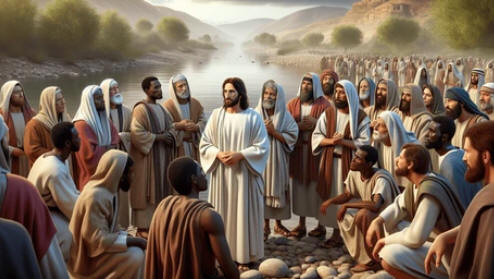
Then Jesus says to the crowd: “So, what do you think about this?
A certain man had two children, and, going to the first
one, he said, 'My child, go and work in my vineyard today.'
He replied: 'I don't want
to go', but then he repented and went.
And going to the second,
he said the same. He replied, saying, 'I will go, master’; but
he did not go. So, which of the two had done the father’s will?
They said to him, ‘the first one’.”
Jesus once again checks them by using parables,
here
alluding to the
ingratitude of the Jews as well as to the obedience of the
Gentiles - who were despised by them exceedingly - because that
is what the two sons portray, inasmuch as it portrayed what was
happening with the Gentiles and the Jews.
For the Gentiles – albeit
not having promised to obey or heed the Law -
finally proved their
obedience with their works.
Whereas the Jews – albeit stating
that “all that God has said, we will do,
and we will heed; for Moses had recited these words to God”
[Exodus 19:8] - in practice they did not uphold what they
claimed, but instead disobeyed.
So, lest they believe that the Law alone is beneficial to them,
they
are being shown how that very Law itself condemns them – a
thing that Paul also highlights, as follows: “For the mere listeners of the Law are not righteous before God; it is
the doers of the Law who will be vindicated' (Romans
2:13).
Wanting to make them
accuse themselves on their own, He prepared things in such a way
that they would be able to reach a decision on their own – which
He did, by means of the present parable of the vineyard.
To achieve this result, He places the accusation on
another person in the parable: that of the second son. Given
that it would not have been possible to extract their confession
immediately, He guided them by means of the parable to where He
wanted.
Realizing that they had not understood the meaning of His words
and had made their decision, He then revealed what He was
implying and clarified: “Verily I say to you
(implying the Scribes and the Pharisees),
that tax collectors and prostitutes will precede you into the
realm of God; for they had initially shown disobedience to the
Law, but you only show obedience to God with words. For John had
come to you on the path of righteousness
(=preaching to you the path of virtue and the virtuous way of
life and behaviour)
and you did not believe him; the scribes and the
pharisees believed him. But you, even having seen him, did not
afterwards repent and believe in Him”...
If He had merely said that ‘prostitutes will precede
you...’ the words would have
annoyed them, whereas now, after formulating His thought upon
hearing their opinion, His words seemed more tolerable. It was
for this reason that He also added the reason.
So what was that reason? “For he – John – came to
you” (not ‘them’);
and not only that, but also “on
the path of righteousness”. Nor can you of course accuse
him of being an indifferent person and his words being of no
use, given that even his
very way of life was irreproachable and his care was profound...
Nevertheless, you didn’t pay attention to him.
And together with this, he accuses them of another thing,
namely, that even tax collectors had paid attention to him;
and after this
accusation, he accuses them of yet another thing, namely, that
they didn’t pay attention to him
even after the tax
collectors had. Of
course they should have believed before the tax collectors,
but the fact that they did not believe - even after them - is
unforgivable. Hence
the praises for them (the
Gentiles)
is indescribable, as are the accusations for the others (the
tax collectors). “He
had come to you and you did not accept Him; He had not
gone to them, and yet they accepted Him, while you did
not accept them - even as your teachers.”
Notice in how many ways the praise of the Gentiles and the
accusation of the Jews was pointed out. “He
had come to you” (the Jews), “not to them” (the
Gentiles). “You did not believe; but that did not scandalize them.
They believed, but
that did not benefit you.”
Also, he did not say the phrase “precede you into the realm of God” - implying that they too
will enter - after the others. He said this intending to
show that there is hope for something similar – should they
desire it.
Nothing arouses those who are spiritually imperfect as
much as jealousy.
This is why He always said: “Many
who are first shall be last, and the last shall be first”
(= many who are first in this world will be last in the next
world, and many who are last here will be first there) [Matthew
19:30].
It was also the reason he had referred to tax collectors and
prostitutes: to arouse their jealousy – given that
these two worst sins are
born of unnatural love, one from physical lust, while the other
from the lust for riches. He
thus proves to them that this primarily means obeying God's law
- that is, believing John’s words.
As such, it meant
that it was not solely
the result of divine grace that prostitutes would enter the
heavenly realm, but also of righteousness, inasmuch as they
would not be entering while having remained prostitutes, but
would be entering after having obeyed, believed, were cleansed,
and had changed their way of life.
Did you notice how Paul made his words tolerant and more
effective by means of a parable and
the mention of
prostitutes? He did not
say to them right from the beginning: “Why
didn’t you believe John’s
words?” Instead,
after first mentioning that which was most indicative - namely,
the tax collectors and the prostitutes – he then he added the
rest, maintaining a control through his reference of the natural
order of things, showing
that they did everything out of their fear of people and their
own vainglory. Given that
they also hadn’t believed
in Christ for fear of being excommunicated from the synagogue,
they likewise didn’t dare to accuse John - not for religious
reasons again, but out of fear.
He checked all these things with everything that he said, then
added another blow - more drastically - with the following
words: “But
you, having seen them (who
had believed), did not
repent afterwards, and believe in Him”
[Matthew 21:32]. It was a
bad preference indeed, that they had not chosen from the start
what was good; but the accusation is even greater, for not
having repented afterwards, as
this above all
is what makes many people wicked – a thing that I see
even now happening to some, when overcome by the worst kind of
insensitivity.
But let no one be thus;
even if they become possessed by the most terrible wickedness,
let them not be overwhelmed by despair after their change for
the better, as it is easy to be dragged out of the pits of
wickedness. Or haven’t you perhaps heard of that prostitute who
exceeded everyone in lewdness, yet finally exceeded everyone
with her piety after repenting?
I am not referring to the one mentioned in the gospels,
but the prostitute of our generation, who originated from the most illicit city, Phoenicia,
being once a prostitute who lived among us, who was the first in
appreciation in the theaters and her name was well known
everywhere, not only in our own city, but also as far as the
land of the Cilicians and the Cappadocians.
She too had squandered
many fortunes, and had left many orphaned; many also accused her
of magic - that is, that she trapped victims in her nets, not
only with her bodily beauty, but also with those magical
medicines of hers. In
fact, this prostitute had also seduced the queen's brother, for
her power was so immense.
But all of a sudden - I don’t know how, or rather, I know very
well:
she willingly repented
and had thus attracted the grace of God; she had forsaken all
the wicked things she had done, and, having rejected the
sorceries of the devil, she was ushered swiftly into heaven.
Although there was nothing more obscene than her when she worked
in the theater, nevertheless,
with her pursuant,
extreme self-control and after donning the sack-cloth of
repentance, she lived the rest of her life with this practice of
strict ascesis.
Because of this phenomenon however, she had also aggravate a
first officer and the soldiers, who came against her,
threatening her with weapons to resume her old life, but they
were not able to bring her back on stage at the theater, nor
remove her from the cloister of virgins
who had welcomed her to her repented life.
Later on, having been found worthy of the ineffable mysteries by the
Lord, and having displayed a zeal worthy of divine grace, she
departed from this life, having cleansed all her sins by the
grace of God and by having shown exteme piety after her baptism.
She had furthermore refused to even be simply seen by former
admirers and lovers who sought her for their usual purpose;
for she had totally
isolated herself and had spent the rest of her life as if living
in a prison.
This is the only way that “the last will come first and the
first last”: by ensuring that our soul remains ever aflame by the fire of faith,
there will be no obstacle for one to become great and wondrous.
Therefore let no-one who may be living in sin fall into
despair, and let no-one of the virtuous remain idle and becoming over-confident of their virtue, for very
often, even a prostitute can surpass them in virtue, after
having repented. But neither should any sinner be overcome by
despair, because it
is possible for them to surpass even the first.
Note carefully what God had said to Jerusalem: “And
I said all these things, after she had fornicated: Turn back to
Me; and she did not return.” [Jer.3:7].
Even after their
idolatry and their deviation into fornication, He invited them
to return to Him with repentance, but they did not return!
When we return to the fervent love for God, God will not recall
the precedent acts that we had committed while living in sin.
God is not like people, for He does not rebuke our past deeds,
nor does He ask us after repenting: “What took you so long?”; He
just loves us when we do return to Him, as long as we return the
way we should.
FOR THE GLORY OF THE HOLY TRIUNE GOD Translation A.N. |
Article created : 15-11-2025
Last update on: 15-11-2025