| Orthodox Outlet for Dogmatic Enquiries | Church Fathers |
|---|
Saint Augustine on Original Sin
Influenced by erroneous Platonic views
By
Fr. John Romanides
Source: 'Empirical Dogmatics of the Orthodox Catholic Church
according to
the oral traditions of Fr. J. Romanides', Volume II.
Excerpts by Rev. Metropolitan Hierotheos Vlachos of Nafpaktos and Saint
Vlasios
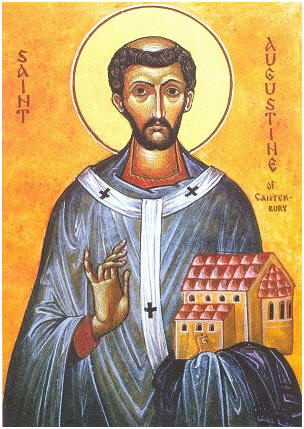
|
[...]
“First of all, Augustine begins with Platonic prerequisites. He
abandons some of the Platonic positions,
and
tries to
again
“adjust” Plato to Christianity.
Contradictions
were inevitable thereafter”.
“Augustine inserted Platonic concepts into the doctrine of the Holy
Trinity. He introduced the idea that Adam and Eve had in full all
possible human knowledge that one could have. This was to be
expected, given that for Augustine, human knowledge consists of a
vision of the archetypes: if one knows the archetypes, he knows God,
then he knows the essence of God. Adam and Eve knew all the
archetypes, hence possessing all the knowledge that a human being
can have. Τhe
Westerners imagined the first-fashioned humans
created
as perfect beings – perfect, according to Platonic thinking. When
they fell, they supposedly
relinquished
the memory of those archetypes, which
is why throughout his life,
Augustine always gave great importance to man’s memory.
He believed that the
knowledge pertaining to God was imprinted in a person's memory. And
according to Augustine, “illumination” was about man’s regaining the
memory of those things that pertain to God. Now, how Augustine
combined this, with his teaching on the pre-existence of souls
(which he finally rejected), is a huge problem in Augustine's
thinking.”
“Man’s
illumination
- according to him -
simply means that the nous
(mind) is familiar with the archetypes. That's what
illumination is. Then
the deification (theosis) of
man is when man has been deified and can directly see the archetypes
with his logic.” Then -per the Platonic concepts- Augustine believed that after man’s fall, the passive (impassioned) part of the soul was added to him, which governed desiring and temperament:
“Augustine has this idea that man was perfect and that he had divine
Grace - that he had no desire and no temper; that his cognitive part
was in the state of bliss, and so on. But because of the fall, the
desiring and the temperamental condition appeared.' He then teaches that the ancestral (original) sin was an affront to God's justice and it was for this that man was punished. He does not perceive death as a disease that is the result of one's loss of the divine life, but as God's punishment upon man:
“What is significant for Augustine is that he thinks of death as
God's punishment. Everyone was punished by God, because they have
guilt.” It is with these prerequisites that we must see Augustine's view of original sin as an affront to God's justice, as well as the juridical and guilt-ridden interpretation of sin; of how this guilt was passed on to the human race, and how this view is linked to absolute predestination:
“According
to Augustine, when Adam and Eve sinned, they sinned against God's
righteousness and offended the infinite God.
Subsequently, since everyone
inherits the sin of Adam and Eve (namely guilt), this means that
everyone must be punished, according to their merit. Therefore, we
are all punished by God, depending on merit; however, because God
wills thus, among those condemned to eternal Hell, He has chosen a
group for salvation.
Therefore, in this way, those who have not been chosen for salvation
cannot complain, because they are punished according to their merit.
In which case they should even rejoice, inasmuch as divine justice
will have prevailed. But as for those who will be saved, nor can
they can
assert
that they are saved according to their merit, because salvation for
them is absolutely free, without any worthiness
of theirs. As such, they cannot boast.
In this context, an indication that someone is predestined is also
that one is a good person. In other words, for Protestants, this
means he is temperate, does not steal, does not lie, does not go
around with women
- in short,
he is a good man. Thus they divide people into good and bad.
Apart from this - mainly in
the Anglo-Saxon world and also among the Franks - it was because of
Augustine's teaching that racism found support. Thus, those
predestined for salvation had to be (let’s say)
the fair-skinned, the tall, the blonde, etc. etc. that is,
the
persons
who
are
beautiful in appearance. If a person is hideous in appearance, poor,
devastated, miserable, a serf, a cripple etc., for the Franks it was
not possible for these
to be predestined”. It follows that Augustine's views on original sin were linked to the theory of man's absolute predestination, which distorts God's love for man, the purpose of Christ's sacrifice on the Cross and the overall poemantic care of the Church:
“Everyone was punished by God, because everyone has guilt. The
problem is how they have guilt
-
that is, if the guilt is hereditary in a biological manner, or if it
is guilt in a representative manner, whereby Adam and Eve as
representatives of mankind had sinned and, therefore, not only were
the representatives punished, but also the entire human race.
Another approach is that they lost something at the expense of the
entire human race, simply by being representatives. Just like a
father who does stupid things and loses his property, and because of
the father, the children are born destitute. The children are
thereafter indigent, because the father, who was rich, had lost his
property. This is the other perception; it depends on what each of
us wants to extract from Augustine regarding these issues. But what
matters from God's point of view is how the issues actually are.
Augustine embraces the teaching of absolute predestination. He
therefore introduces the idea that all people, according to their
worthiness, are condemned for Hell. This condemnation is determined
by the merit of man. But God, who is also love, does not allow His
entire handiwork to be completely lost, and has predestined certain
people for salvation. Only a part of humanity is predestined for
salvation.
But this predestination of
only
a part of humanity is not attributed to man's deserved wages,
because it is according to their
worthiness
that people must go to Hell. Therefore, the ones
who will receive divine Grace in order to be saved, cannot boast
that
they
were
saved depending on
their
works, but were
saved by the predestination that
they
have
from God,
per
His will. That is why
one
must be humble and sit quietly and not imagine
that he is better than others in terms of
worthiness.
But neither should a person who is not predestined
complain, for he is punished
according to his worthiness.
In this regard, Augustine has another strange idea, that when we say
that God loves sinners, it does not mean that he loves all sinners.
It simply means that God loves the sinners who are predestined.
Other sinners are not loved by God. Hence, His love is restricted.
Adam and Eve sinned, and guilt passed down to all of mankind. And,
because of this guilt, every person deserves Hell. So, if there are
some who are destined for salvation,
God
loves them, because that is how He wills it. Others cannot complain,
because they are punished according to their
worthiness.
They cannot demand to be saved, because according to their
worthiness they are losers. They are losers, because of Adam and
Eve.
They who are saved, are saved, not because of their worthiness, but
because of the love of God Who had chosen them. They should not
boast, but have humility. Thus was created the strange distinction
that God loves sinners who are
predestined.
He does not love them as sinners, he loves them as perfect people.
For sinners are not loved by God.
Then, Christ died so that people could be saved. But Christ did not
die for all people. He died for some. These passages exist in the
writings of Augustine and because of these passages the Franks have
a very strong tendency to believe in absolute predestination.”
If one compares these views by Augustine to the entire teaching of
the Fathers, as briefly expressed above, one can see the difference.
God loves the just and the
unjust, but only those who are healed, those who respond freely to
God's love and themselves acquire selfless love will be justly
judged
finally.
This is done by the power of Christ.
English text
|
