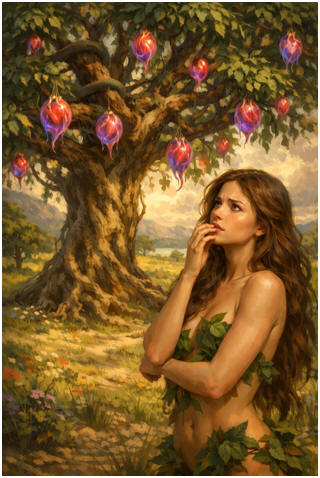
Source:
https://logoslibrary.org/irenaeus/heresies/523.html
|
He had indeed been already accustomed to lie against
God, for the purpose of leading men astray. For at the beginning,
when God had given to man a variety of things for food, while He
commanded him not to eat of one tree only, as the Scripture tells us
that God said to Adam:
“From every tree which is in the garden thou shalt
eat food; but from the tree of knowledge of good and evil, from this
ye shall not eat: for in the day that ye shall eat of it, ye shall
die by death;” he then, lying against the Lord, tempted man, as
the Scripture says that the serpent said to the woman: “Has God
indeed said this, Ye shall not eat from
every
tree of the garden?”
And when she had exposed the falsehood, and simply
related the command, as He had said, “From every tree of the
garden we shall eat; but of the fruit of the tree which is in the
midst of the garden, God hath said, Ye shall not eat of it, neither
shall ye touch it, lest ye die:” when he had [thus] learned from
the woman the command of God, having brought his cunning into play,
he finally deceived her by a falsehood, saying, “Ye shall not die
by death; for God knew that in the day ye shall eat of it your eyes
shall be opened, and ye shall be as gods, knowing good and evil.”
In the first place, then, in the garden of God he
disputed about God, as if God was not there, as if he was ignorant
of the greatness of God; and then, in the next place, after he had
learned from the woman that God had said that they should die if
they tasted the aforesaid tree, opening his mouth, he uttered the
third falsehood, “Ye shall not die by death.”
But that God was true, and the serpent a liar, was
proved by the result, death having passed upon them who had eaten.
For along with the fruit they did also fall under the power of
death, because they did eat in disobedience; and disobedience to God
entails death. Wherefore, as they became forfeit to death, from that
[moment] they were handed over to it.
Thus, then, in the day that they did eat, in the same
did they die, and became death’s debtors, since it was one day of
the creation. For it is said, “There was evening, and there was
morning - day one.” Now in this same day that they did eat, in
that also did they die. But according to the cycle and progress of
the days, after which one is termed “first”, another “second”, and
another “third”, if anybody seeks diligently to learn upon what day
out of the seven it was that Adam died, he will find it by examining
the dispensation of the Lord.
For by summing up in Himself the whole human race
from the beginning to the end, He has also summed up its death. From
this it is clear that the Lord suffered death, in obedience to His
Father, upon that day on which Adam died while he disobeyed God. So
he died on the same day in which he did eat. For God said, “In
that day on which ye shall eat of it, ye shall die by death.”
The Lord, therefore, recapitulating in Himself this
day, underwent His sufferings upon the day preceding the Sabbath,
that is, the sixth day of Creation, on which day man was created;
thus granting him a second creation by means of His passion, which
is that [creation] out of death.
And there are some, again, who relegate the death of
Adam to the thousandth year; for since “a day of the Lord is as a
thousand years,” he did not overstep the thousand years, but died
within them, thus bearing out the sentence of his sin.
Whether, therefore, with respect to disobedience,
which is death; whether [we consider] that, on account of that, they
were delivered over to death, and made debtors to it; whether with
respect to [the fact that on] one and the same day on which they ate
they also died (for it is one day of the creation); whether [we
regard this point], that, with respect to this cycle of days, they
died on the day in which they did also eat, that is, the day] of the
preparation, which is termed “the pure supper,” that is, the sixth
day of the feast, which the Lord also exhibited when He suffered on
that day; or whether [we reflect] that he (Adam) did not overstep
the thousand years, but died within their limit,it follows that, in
regard to all these significations, God is indeed true.
For they died who tasted of the tree; and the serpent
is proved a liar and a murderer, as the Lord said of him: “For he
is a murderer from the beginning, and the truth is not in him.”
|
