|
1. In a still clearer light has John, in the Apocalypse, indicated
to the Lord's disciples what shall happen in the last times, and
concerning the ten kings who shall then arise, among whom the empire
which now rules [the earth] shall be partitioned. He teaches us what
the ten horns shall be which were seen by Daniel, telling us that
thus it had been said to him: "And the ten horns which thou sawest
are ten kings, who have received no kingdom as yet, but shall
receive power as if kings one hour with the beast. These have one
mind, and give their strength and power to the beast. These shall
make war with the Lamb, and the Lamb shall overcome them, because He
is the Lord of lords and the King of kings."
1
It is manifest, therefore, that of these [potentates], he who is to
come shall slay three, and subject the remainder to his power, and
that he shall be himself the eighth among them. And they shall lay
Babylon waste, and burn her with fire, and shall give their kingdom
to the beast, and put the Church to flight. After that they shall be
destroyed by the coming of our Lord. For that the kingdom must be
divided, and thus come to ruin, the Lord [declares when He] says:
"Every kingdom divided against itself is brought to desolation, and
every city or house divided against itself shall not stand.2"
It must be, therefore, that the kingdom, the city, and the house be
divided into ten; and for this reason He has already foreshadowed
the partition and division [which shall take place].
Daniel also says particularly, that the end of the fourth kingdom
consists in the toes of the image seen by Nebuchadnezzar, upon which
came the stone cut out without hands; and as he does himself say:
"The feet were indeed the one part iron, the other part clay, until
the stone was cut out without hands, and struck the image upon the
iron and clay feet, and dashed them into pieces, even to the end."
3
Then afterwards, when interpreting this, he says: "And as thou
sawest the feet and the toes, partly indeed of clay, and partly of
iron, the kingdom shall be divided, and there shall be in it a root
of iron, as thou sawest iron mixed with baked clay. And the toes
were indeed the one part iron, but the other part clay."
4
The ten toes, therefore, are these ten kings, among whom the kingdom
shall be partitioned, of whom some indeed shall be strong and
active, or energetic; others, again, shall be sluggish and useless,
and shall not agree; as also Daniel says: "Some part of the kingdom
shall be strong, and part shall be broken from it. As thou sawest
the iron mixed with the baked clay, there shall be minglings among
the human race, but no cohesion one with the other, just as iron
cannot be welded on to pottery ware."
5
And since an end shall take place, he says: "And in the days of
these kings shall the God of heaven raise up a kingdom which shall
never decay, and His kingdom shall not be left to another people. It
shall break in pieces and shatter all kingdoms, and shall itself be
exalted for ever. As thou sawest that the stone was cut without
hands from the mountain, and brake in pieces the baked clay, the
iron, the brass, the silver, and the gold, God has pointed out to
the king what shall come to pass after these things; and the dream
is true, and the interpretation trustworthy."6
2. If therefore the great God showed future things
by Daniel, and confirmed them by His Son; and if Christ is the stone
which is cut out without hands, who shall destroy temporal kingdoms,
and introduce an eternal one, which is the resurrection of the just;
as he declares, "The God of heaven shall raise up a kingdom which
shall never be destroyed,"7--let
those thus confuted come to their senses, who reject the Creator
(Demiurgum), and do not agree that the prophets were sent beforehand
from the same Father from whom also the Lord came, but who assert
that prophecies originated from diverse powers. For those things
which have been predicted by the Creator alike through all the
prophets has Christ fulfilled in the end, ministering to His
Father's will, and completing His dispensations with regard to the
human race. Let those persons, therefore, who blaspheme the Creator,
either by openly expressed words, such as the disciples of Marcion,
or by a perversion of the sense [of Scripture], as those of
Valentinus and all the Gnostics falsely so called, be recognised as
agents of Satan by all those who worship God; through whose agency
Satan now, and not before, has been seen to speak against God, even
Him who has prepared eternal fire for every kind of apostasy. For he
did not venture to blaspheme his Lord openly of himself; as also in
the beginning he led man astray through the instrumentality of the
serpent, concealing himself as it were from God. Truly has Justin
remarked: That before the Lord's appearance Satan never dared to
blaspheme God,8
inasmuch as he did not yet know his own sentence,9
because it was contained in parables and allegories; but that after
the Lord's appearance, when he had clearly ascertained from the
words of Christ and His apostles that eternal fire has been prepared
for him 10
as he apostatized from God of his own free-will, and likewise for
all who unrepentant continue in the apostasy, he now blasphemes, by
means of such men, the Lord who brings judgment [upon him] as being
already condemned, and imputes the guilt of his apostasy to his
Maker, not to his own voluntary disposition. Just as it is with
those who break the laws, when punishment overtakes them: they throw
the blame upon those who frame the laws, but not upon themselves. In
like manner do those men, filled with a satanic spirit, bring
innumerable accusations against our Creator, who has both given to
us the spirit of life, and established a law adapted for all; and
they will not admit that the judgment of God is just. Wherefore also
they set about imagining some other Father who neither cares about
nor exercises a providence over our affairs, nay, one who even
approves of all sins.
************************************************
Footnotes:
1.
Revelations 17:12-14.
2. Matthew 12:25.
3. Daniel 2:33-34.
4. Daniel 2,41-42.
5. Daniel 2:42-43.
6. Daniel 2:44-45.
7. Daniel 2:44.
8. On that prior to Christ's Coming satan was not certain of
his eternal damnation: on the contrary, he actually had a
secret hope for salvation, wihch is why he had not dared blaspheme
the Lord, or think of any mutiny against Him - which we read not
only in Justin and Irenaeus, but also in Epiphanios (Panarios,
her.39,Η΄ PG 41,676 Α-B), in the author of the poems Adversus
Marcionem (in the works of Tertullian, book 1, chapter 3; PL
2,1057 Α), in Isidore of Pelusium (Book 2, ref.90 Apollonius
Episkopus PG 78,533) and in Ecumenius (Memorandum on 2 Peter;
PG 119,573C). Based on this view may have been the belief of
certain ancients that the devil had not yet realized he was
condemned, nor that eternal punishment awaited him. He was to
realize this during the final judgment.
9. Eusebius, Ecclesiastic History, D: 18,9 (Book of Hellenic
Fathers 19,303, 2-4). It is unknown from which work of Justin
the exerpt originates, which is preserved by Eusebius.
10. Cmp. Matthew 25:41.

|
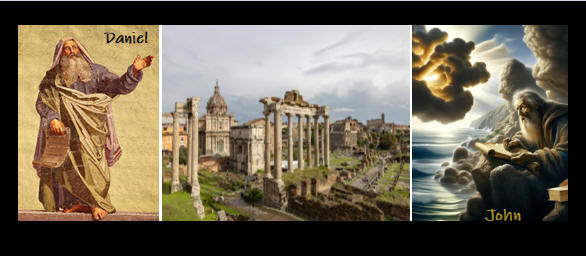 JOHN AND DANIEL HAVE PREDICTED THE DISSOLUTION AND DESOLATION OF
THE ROMAN EMPIRE,
WHICH SHALL PRECEDE THE END OF THE WORLD AND THE ETERNAL KINGDOM
OF CHRIST.
THE GNOSTICS ARE REFUTED, THOSE TOOLS OF SATAN,
WHO INVENT ANOTHER FATHER DIFFERENT FROM THE CREATOR.
JOHN AND DANIEL HAVE PREDICTED THE DISSOLUTION AND DESOLATION OF
THE ROMAN EMPIRE,
WHICH SHALL PRECEDE THE END OF THE WORLD AND THE ETERNAL KINGDOM
OF CHRIST.
THE GNOSTICS ARE REFUTED, THOSE TOOLS OF SATAN,
WHO INVENT ANOTHER FATHER DIFFERENT FROM THE CREATOR.