ARIUS: THE FATHER OF WESTERN HERESIES
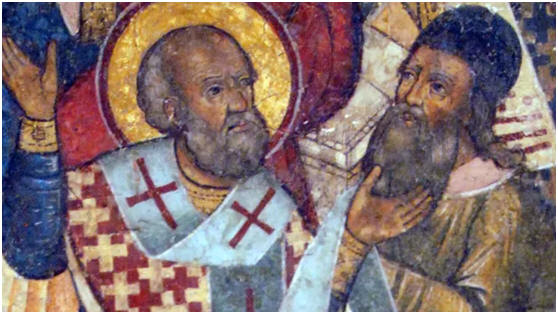
Saint Nicholas angered by Arius during the 1st Council at Nicea 325 AD (according to tradition)
|
Transcript of a radio broadcast by the Church of Piraeus, in its series of programs titled "Orthodoxy and Heresy", by B' Biblikos and collaborators - Homily No. 88 *****************
The study that
we will be reading to you today is titled: “From
the Arianism of Arius to Modern European Arianism”,
published in 1925. Albeit quite old, nevertheless, all the ideas are
contemporary and they also touch on contemporary problems, many of
which regard Christ - in one way or another – as just a man who
lacks divinity; for example, that He is simply a “good person”, a
“sage” - or even worse, when some who, albeit claiming to be
Christians, nevertheless, reduce Christ to the level of a mere
created being.
Before we begin reading the study by Saint Justin, we would like to
remind you that
Saint Justin Popovic reached the end of this life on
the day of the Annunciation, the 6th of April in 1979, which
however also happened to be the day his life began - also on the
feast of the Annunciation in the year 1894, in Serbia. He had served
the Lord throughout his entire life and with all his strength, until
the very end of this life.
So let’s now begin to read his text:
“The mystery of evil is not lesser than the mystery of good. The
mystery of the former is often more appealing than the mystery of
the latter- and man loves the mysterious, in whichever versions it
may be.
There is nothing in the world that man can explain fully and state:
‘Behold this thing - in which and around which - there is no mystery
and is not mysterious’. In every phenomenon in the world, and in
every thing in the universe, there is always something that man
cannot grasp in the cage of his mind. From whichever point of view
we may look at the world, it will appear thus to us: as a query.
The mystery of evil and the mystery of
good, always battle each other in the world, especially within man.
If the philanthropist Lord wasn’t maintaining balance, the world
would have fallen into chaos long ago. The mystery of evil is
artfully appealing. It fascinates man to the point of love, and man
enthusiastically offers himself to its broad and terrible love as a
burnt offering. Whereas the mystery of good is humble and meek,
reviled and spat on in the world.
This
is the reason that fewer are the lovers of the mystery of good and
more are the lovers of the mystery of evil. The mystery of good
would have been led to the grave long ago if Christ had not risen
from the grave and in His resurrected person had not shown all of
His wondrous charm and His appealing beauty.
Pitted against a small good is a small evil, and pitted against a
huge good is a huge evil. Against the weaker athletes of good, Satan
will send his soldiers, whereas against the good God - the Lord
Jesus Christ - Satan himself will come forth.”
Saint Justin then quotes from Matthew
4:1-11 and Luke 4:1-13, where it mentions that directly after His
baptism, the Lord Jesus Christ had departed for the desert and was
tested there by the devil. And Saint Justin continues:
“If anything, this mobilization by the god of evil - of Satan and
all of his army - against Christ, is proof that Jesus is not only a
Person of good, but also the God of good.
Satan’s entire war against Christ has one purpose: to “de-carnate”
the Godman. To drive God out of the human body, out of matter, and
thus dominate matter himself completely; in other words, to prove
that Christ is not God, but merely a simple and weak human, and thus
deter humans from believing in Christ - Who alone is in a position
to defeat the god of evil.
Satan's strategy is ingeniously developed; he thus battles from all
sides against Christ - against His Holy Body (the Church): He
battles against Christ through many and various people: through
Herod and through Nero; but even worse than Nero, through Arius.
Nero fought the Church from the outside, that is, externally. Arius
fought Her from within. Nero killed the disciples of Christ, but
Arius sought to eradicate Christ Himself.
At this point we would like to emphasize
how serious it is for someone to demote the Son and Logos of God to
the level of a creation.
This
is a topic that we constantly touch on, but on which the blessed
father Justin also focuses his attention and his effort to crush.
So he continues:
“If Judas ever had a competitor in his crime, it is Arius, who had
sprung forth from the deicider and suicider Judas.” Father Justin characterizes him as such, because on the one hand Judas was a deicider, by being the one responsible -with his betrayal- for the condemnation and the execution of the God-man Jesus Christ (in His human nature), and also a suicider, because he subsequently committed suicide by hanging himself. So, we repeat:
“...who had sprung forth from the deicider and suicider Judas. Satan
had entered
(“possessed”)
Arius, and through no one else had he acted so thoroughly, as he had
through Arius.”
Saint Justin then exposes Arius’ central teaching: “Arius’ basic idea is that Christ is not God. In his work ‘Thaleia’ he says the following - verbatim: ‘Neither is the Logos a True God.' In relation to God the Father he is not God, and for this reason, he is not perfectly familiar with the Father, nor also with His own essence: The Son did not know his own essence (Thaleia). But neither in relation to people is Christ God; he is only a ‘perfect creation’. It was through moral perfection and the energy of Grace that Christ became what he is, and could thus be called ‘God Almighty’... Christ is not truly God in relation to anyone or anything, and as such, all his characteristics are relative, and relative also is his knowledge and his wills and energies. By nature – as with everyone – neither is the Logos himself immutable.'
These are what Arius states verbatim in
his work “Thaleia”, and Saint Justin continues, exposing
Arius’ central teaching:
“In relation to the world, the Logos is the creator and mediator
between God and the world. God did not directly create the world;
instead, He created the Logos, so that the Logos could create the
world. The Logos was created before everything else.”
He quotes again from “Thaleia”:
“The
Logos came to be, out of non existence; and there was a time when he
was not.”
That is, the Logos supposedly came into being out of nothing, and
that there was a period - a time - when the Logos didn’t even exist
at all...
This, therefore, was the teaching of Arius. And it is so truly
amazing, that the modern, so-called Jehovah’s Witnesses - as genuine
descendants of Arius - advocate exactly the same things about
Christ, by repeating Arius’ impieties and blasphemies.
We will continue reading from the study
by Saint Justin Popovich, which is titled: “From
the Arianism of Arius to Modern European Arianism”.
Father Justin exposes the gravity of Arius’ blasphemy and his
cacodoxy, by theorizing that Jesus Christ was a mere creation; which
is precisely why we are using this study - to discern and realize
the gravity of the delusion that many people have in our time
regarding their faith in Jesus Christ - where some people consider
Him to be a remarkable, great, wise man, and others say they do
believe in Him, but in reality demote Him to the level of a mere
creation – the way that Jehovah’s Witnesses do, for example. So, to continue with Saint Justin:
1.
Arius’ influence on Western heresies
“It was only natural that this teaching of Arius would provoke
opposition among the genuine confessors of the Christian truth. No
persecution, no other suffering had shaken the Church so much, the
way that Arianism had, because this was the worst kind of
persecution. Arius was evicting God from Christ.
That is, he was “removing” divine nature
from the Person of Christ, leaving Him with only His human nature.”
“This is about the worst kind of horror...” (continues Father Justin) “...that Christ is not God!" Either Christ is God, or this world is a laboratory of ghosts and horrors.
There is no salvation, if Christ is not God.
For this reason, in order to defend the
Lord Jesus Christ from the blasphemy of Arius, the entire Church was
up in arms; they gathered together in one, overall and conciliar
corpus,at the First Ecumenical Council, where, in their opposition
to the heresy of Arius they officially formulated the Apostolic and
Overall (‘catholic’) Orthodox teaching; the Apostolic and Overall
(‘catholic’) conscience, the Apostolic and Overall (‘catholic’)
faith and experience;
the
Apostolic and Overall (‘catholic’) tradition.
The Council did not create anything new; it simply expressed and
formulated the ancient faith and teaching of the Church, which had
been sacredly and reverently preserved by the charismatic life of
the Church, through the Holy Spirit.”
The overall (‘catholic’) faith and teaching of the Church was
expressed unanimously in the Symbol of Faith (the ‘Creed’)- and
especially in the powerful term “consubstantial” (Gr.: omo-ousios,
of the same essence).
The entire Christian concept of life is essentially what?
It is the developing of the musical theme that is comprised of
the dogmas – of dogmatics.
And what are dogmatics? The development of the Creed.
And what
is the Creed? Nothing else but the expanded formulation of Baptism,
with the wording: “.......in
the name of the Father and of the Son and of the Holy Spirit”.
And these words are, undoubtedly, the expansion of the word
“consubstantial”.
The word
“con-substantial” expresses precisely that (seemingly
contradictory), ’antinomian’ seed of the Christian perception of
life: it is in the formulation with the words “in the
name
of the Father
and
of the Son
and
of the Holy Spirit”, and not “in the
names
of”
the
three Hypostases. Furthermore, the name of the Father - the Uncreated and Infinite God - cannot be placed with equivalence, or in the same place, as the name of a creation and a thing – as asserted by the modern, so-called Jehovah’s Witnesses, regarding the Son and the Holy Spirit”.
However, we will say much more about this, if the Lord permits, in a
future broadcast. And Saint Justin continues:
“The spirit-bearing Fathers had found the word with which they
expressed the essence of Christianity. ‘They did this, upon
receiving the noetic illumination by the Holy Spirit,’ as our Church
chants. Through the Holy Spirit they revealed the mystery of
theology, and this was what they solemnly deivered to the Church.
And the mystery of theology is this:
“Christ is the
true God, consubstantial with God the Father; and for this reason,
Saviour;
for this reason,
Redeemer;
for this reason,
Lord.”
The God-illumined Fathers - like their Lord when He was tempted in
the desert - had likewise vanquished (through the Holy Spirit) the
unclean spirit of the demonized Arius, and had struck a “decisive
defeat” to the tempter. What is “Arianism” in actuality? Where did it originate from? With its metaphysical “being”, it is rooted in Satanism, and with its psychological aspect, in rationalism.
2.
Replacing Christ with a common human
We would like to observe here, dear
listeners, that Saint Justin is truly providing an anatomy of this
delusion, when telling us that it has two aspects.
One
is the metaphysical or spiritual aspect, which has to do with Satan
- the father of lies and of heresies; the other aspect - the
psychological one - is where he finds support - which is
rationalism; that is, the means that Western man has consistently
used and uses, essentially to displace the metaphysical, and to
displace God from his life.
But we close this small parenthesis, and continue with the words of
Saint Justin:
"Arianism is an attempt to adopt the
methods and means of human philosophy as methods and means for
Christ-knowledge and God-knowledge;
to place the sin-laden human mind as a measure for the in-Grace,
divine-human opus of Christ, so that the rationalistic laws, the
categories of Aristotle's logic will replace the Christian laws of
the Holy Spirit.
Newman is correct when he says:
‘Aristotle is the bishop of the Arians’. Given that Arius wanted to
un-deify the God-man, Saint Athanasius - the divinely inspired mouth
of the First Ecumenical Council and fiery tongue of the Holy Spirit
- showed and proved that Arius is a child of the devil and Hades,
and that his every thought is born of Satan.
Arius
wanted to include the infinite, in-Christ God in the narrow
categories of his finite and limited mind.
The basic error of the Arians is -
according to Saint Athanasius - that "they interpret the Holy
Scripture according to their own mind". This is also why they do not
understand it; because in order to understand the things of Christ,
one must have the mind of Christ (1 Cor. 2:9-16).
Arians measure Christ with
themselves, thus making Christ like themselves. With their own
nature, they measure His nature. That is why they lower it to the
level of a created nature.
Unlike
them, the Church -through Saint Athanasius- teaches that “one must
not compare the birth of the Logos out of God, with
the
nature of humans”.
That is, we should not measure with the same measure and compare and
contrast the birth of God the Logos, to birth by human nature. And
Father Justin continues:
“Satanic is the thought that denies the divinity of Christ; so
satanic, that it must have its beginning in the mind of Satan. It
was from him that the Arians have borrowed it, and it is for this,
that they are devils and friends of his demons.
Every heresy is from the devil.
Having
examined all the heresies in depth, Saint Athanasius writes:
Saint Athanasius emphasizes that the
Arians ‘count themselves among the Hellenes, because they worship
Creation instead of the Creator, by teaching that Christ is a
creation.'
Only the word “consubstantial” is
security against the Arians. One must proceed with a logical
consistency, to the end.
If a terrible thought is permitted,
you had asked ‘who is the one who
could
tell the truth-if not Christ?'
Wouldn’t all men then be accursed
trumpets, through which a certain thrice-accursed lie is trumpeted?
But
because the Lord and God -Jesus Christ- is the infinite truth, it is
possible to not be proven logically but demonstrated naturally.
The god
who can be comprehended, is not God.'
This thought by Saint Athanasius is
deserving of every acceptance. Arianism wanted to comprehend God -
in Christ; to rationalize Him - which is why he was scandalized and
veered into heresy.
This is a gnosiological problem. Are
logical thoughts able to become the means for true Christ-knowledge?
They cannot,
replies the Holy Spirit, through the Holy Fathers of the First
Ecumenical Council.
For one to be led through the nous
(mind) to the central dogma of the faith, signifies a fall into
scandal, which has heresy as a result.
How can the inexhaustible One be
contained within the shell of a walnut - that is - in the human
mind?
How can the Inexpressible be
expressed?
How can the Imperceptible be
perceived?
How can the incomprehensible be
comprehended?
It is not enough for one to invoke
Holy Scripture, because the devil also invokes it. And since he has
a greater need, he invokes it all the more – which he did, when he
tempted the Lord in the desert.
Arianism is paganism resurrected,
because it reduces the Godman Christ, to the levels of a demigod.
In the broken (because of sin) mirror
of the human mind, God is also seen fragmented.
‘By faith we know, for by faith we
walk, by faith we live’
(2 Cor.1:24; Gal.2:20; Rom.1:7, 1:17, etc.).
What else inside me can find and know
God in Christ, if not faith?
The following words by Saint
Athanasius are infinitely true:
‘To research the Holy Scriptures and for true Christ-knowledge,
there is need of a good life and a pure soul and the in-Christ
virtue, a clear intellect, and the emulation of the Saints’ lives.’
We notice, dear listeners, that these are the basic characteristics
- which are prerequisites - for the correct understanding of the
Holy Scriptures and the dogmas of the faith. And Saint Justin
continues: “As blasphemy against the Holy Spirit, Saint Athanasius considers the denial of Christ’s divinity and the disrespect regarding His divine essence."
After quoting from Saint Athanasius the prerequisites to acquaint
oneself with the dogmas of truth and faith, Saint Justin continues:
“For one to want to know God with his
sin-soaked mind and to explain Him, constitutes the work of a
fornicated conscience. The Holy Fathers and the Holy Church of
Christ know this well, and it was for this reason that Arius was
excised as a diseased member.
Arius, having adulterated the Orthodox faith with an ungrateful
mind, was ostracized by paternal votes from the Church as a rotted
member, that ill-named one.
And the Holy Fathers, who through the virtues of the Holy Spirit
transformed their minds and united them through Grace with the
overall (catholic) and holy nous (mind) of the Church of Christ,
became the trumpets of the Spirit, through whom the Holy Spirit
spoke the mystery of Theology, the mystery of the Hypostasis of the
God-Man Christ.
4. Arius as father of modern Europe
Arianism has not been buried yet. Today it is more fashionable than
ever, and it has spread more than ever before. It has dissipated,
like a soul, into the body of modern Europe.
And if you observe the culture of Europe - in its depths - you will
see Arianism hidden inside it. Here, everything is confined to man
only, and the God-man Christ Himself they have reduced to man’s
frameworks.
The leaven of Arianism has been kneaded
into the philosophy of Europe, its science, its culture and in part,
its religion. Everywhere and systematically, Christ is being reduced
to a simple human. The Godman continues to be de-humanized.
Arius’
work is being incessantly executed.
Kant's religion, within the limits of pure reason, is nothing more
than a version of Arianism. If we measure Christ by Kant's standard,
what do you think we will have as a result?
We will have a human Christ; a wise Christ, but never a God-human
Christ.
If we judge Christ by Bergson's criterion, we will again have
something that is a little more than a simple human. And thus both
the one criterion and the other, and all the criteria of all
philosophies according to man, reduce the God-man Christ to a mere
human.
European science is no less than philosophy in its Arian
relationship to Christ.
Protestantism, through many of its representatives, has largely
surpassed Arianism, even Arius himself.
The various Socinians and Schleiermachers are powerful competitors
of Arius in de-carnating the incarnated God.
As for papism with its morality, it is by far Arian. One wonders,
does it feel what metaphysics stand behind its terrible morality?
All of the above together have succeeded in poisoning the vast
masses of Europe with vulgar Arianism.
Who is not familiar with the vulgar Arianism of our intellectuals?
Our many intellectuals often say: “Christ is a great person, a wise
man, the greatest philosopher, but definitely not God.” Where has so
much Arianism come from today?
From the fact that man has become the measure of all things today,
the measure of all visible and invisible beings and things. By
measuring everything compared to himself, European man rejects
everything that is broader than man, greater than man, more infinite
than man. His narrow measuring narrows the God-man, to a plain
human.
The bark of sin clamps the proud mind of man and he thus doesn’t see
and doesn’t recognize any reality that is greater than himself.
The ‘beyond the mind’ feat of faith in the God-man Christ, breaks
this clamp and opens the nous (mind) to the infinite realities.
The First Ecumenical Council determined
once and for all the role of the nous (mind) in the interpretation
of the God-man Christ’s personality: Its role is that of obedience.
In Christianity, faith guides, and the nous (mind) is guided.
Knowledge is the fruit of faith activated through love,
and
working in hope.
Contemporary European relativism follows Arianism. Metaphysical
relativism also gave birth to the moral one. Nothing absolute exists
- not above the world or man, nor in the world or in man, nor also
around the world or man.
But even from this newer relativism, as well as from the old Arian
one, only faith in the God-manhood of the Savior Christ, in His
consubstantiality with God the Father saves us. Ergo, the wondrous
word “consubstantial” saves.
Test your faith and check it with the Symbol of Faith. If your faith
does not correspond fully to the Symbol, you are a heretic. If you
reject the “consubstantiality”, you are not of Christ, you are of
the Antichrist, you are of Judas, because the Church has named Arius
a ‘second Judas’.”
But let us close here with the words and this study by Saint Justin,
and also close today’s broadcast, which has come to an end.
Thank you for listening in. We also thank Kostas Tziotzios, who was
in charge of the audio.
Rejoice, and may God be with us.
|
