Kindle in our hearts, O God,
The flame of that love which never ceases,
That it may burn in us, giving light to
others.
May we shine forever in Thy holy temple,
Set on fire with Thy eternal light,
Even Thy son, Jesus Christ,
Our Savior and Redeemer.
With the imagery of fire and light contained in
this wonderful prayer I want to move immediately
to a recorded incident in the life of St.
Columban, a description which shows how he
himself personally experienced this "light" -
which of course Orthodox Christians recognize as
a vision of the Uncreated Light spoken of in
Scripture and in the Holy Fathers. Here is the
account:
"One winter's night a monk named Virgnous,
burning with the love of God, entered the church
alone to pray. The others were asleep. He prayed
fervently in a little side chamber attached to
the walls of the oratory. After about an hour,
the venerable Columban entered the same sacred
house. Along with him, at the same time, a
golden light came down from the highest heavens
and filled that part of the church. Even the
separate alcove, where Virgnous was attempting
to hide himself as much as he could, was also
filled, to his great alarm, with some of the
brilliance of that heavenly light. As no one can
look directly at or gaze with steady eye on the
summer sun in its midday splendor, so Virgnous
could not at all bear the heavenly brightness he
saw because the brilliant and unspeakable
radiance overpowered his sight. This brother, in
fact, was so terrified by the splendor, almost
as dreadful as lightning, that no strength
remained in him. Finally, after a short prayer,
St. Columban left the church.
The next day he sent for Virgnous, who was very
much alarmed, and spoke to him these consoling
words: 'You are crying to good purpose, my
child, for last night you were very pleasing in
the sight of God by keeping your eyes fixed on
the ground when you were overwhelmed with fear
at the brightness. If
you had not done that, son, the bright light
would have blinded your eyes. You must never,
however, disclose this great manifestation of
light while I live.'" It's no wonder, then, that
ancient writers said that, on the faces of
Celtic monks who had advanced in spiritual life,
there rested the glow of caeleste lumen,
heavenly light."
In the life of St. Adomnan we read about the
following incident:
"At another time when the holy man was
living in the island of Hinba, the Grace of
the Holy Spirit was poured out upon him
abundantly and in an incomparable manner,
and continued marvelously for the space of
three days, so that for three days and as
many nights, remaining with a house barred,
and filled with heavenly light, he allowed
no one to go to him, and he neither ate nor
drank. From that house streams of
immeasurable brightness were visible in the
night, escaping through chinks of the door
leaves, and through the key-holes. And
spiritual songs, unheard before, were heard
being sung by him. Moreover, as he
afterwards admitted in the presence of a
very few men, he saw, openly revealed, many
of the secret things that have been hidden
since before the world began. Also
everything that in the Sacred Scriptures is
dark and most difficult became plain, and
was shown more clearly than the day to the
eyes of his purest heart. And he lamented
that his foster-son Baithene was not there,
who if he had chance to be present during
those three days, would have written down
from the mouth of the blessed man very many
mysteries, both of past ages and of ages
still to come, mysteries unknown to other
men..."
(Fr. Gorazd Vorpatrny, "Celts
and Orthodoxy,"
http://www.orthodoxireland.com/history/celtsandorthodoxy/view
)
In
the Introduction to his translation of the Vita
Patrum: The Life of the Fathers, the Righteous
Fr. Seraphim of Platina wrote appreciatively
about the Orthodox saints of the pre-schism
West in Gaul, but of course he could have
been writing about the Celtic saints of the
British Isles from exactly the same period
of time.
"A
touchstone of true Orthodoxy," Fr. Seraphim
wrote, "is the love for Christ's saints. From
the earliest Christian centuries the Church has
celebrated her saints-first the Apostles and
martyrs who died for Christ, then the
desert-dwellers who crucified themselves for the
love of Christ, and the hierarchs and shepherds
who gave their lives for the salvation of their
flocks.
From the beginning the Church has treasured the
written Lives of these her saints and has
celebrated their memory in her Divine services.
These two sources -the Lives and services- are
extremely important to us today for the
preservation of the authentic Orthodox tradition
of faith and piety. The false 'enlightenment' of
our modern age is so all-pervasive that it draws
many Orthodox Christians into its puffed up
'wisdom,' and without their even knowing it they
are taken away from the true spirit of Orthodox
and left only with the shell of Orthodox rites,
formulas, and customs....To have a seminary
education, even to have the 'right views' about
Orthodox history and theology-is not enough. A
typical modern 'Orthodox' education produces,
more often than not, merely Orthodox
rationalists capable of debating intellectual
positions with Catholic and Protestant
rationalists, but lacking the true spirit and
feeling of Orthodoxy. This spirit and feeling
are communicated most effectively in the Lives
of saints and in similar sources which speak
less of the outward side of correct dogma and
rite than of the essential inward side of proper
Orthodox attitude, spirit, piety."
With this principle in mind-that the lives of
the saints are of critical importance if we are
to understand and pass on true Orthodox
Christianity to the next generation-I want to
continue by defining two important terms:
"Celtic" (or "Celt") and "spirituality."
It
may come as a surprise to learn that the Celts
actually never called themselves "Celts." This
word comes from the Greek Keltos, and means
something like "the other" or "a stranger." The
Greeks also called these people Keltoi, which
was a word the Celts did adopt because it means
"the hidden ones" or the "hidden people." In
fact, the Old Irish word ceilid means "to
hide or conceal." So these people were called
"Celts" by those who came into contact with them
and saw them as being quite different than other
tribes and peoples. And they were. In their
long, preChristian period they were a ferocious
war-loving lot who fought just for the sheer joy
of fighting. "One Roman writer described Celtic
men as 'terrible from the sternness of their
eyes, very quarrelsome, and of great pride and
insolence'. Nor, to his dismay, did these
qualities stop with the men. 'A whole troop of
foreigners [he wrote] would not be able to
withstand a single one if he called to his
assistance his wife, who is usually very
strong.' The Greek historian Strabo was more
blunt in his assessment. 'The whole race,' he
concluded, 'is war mad.'"
(No author given; Heroes of the
Dawn: Celtic Myth)
Christianity softened all of this, but
Celtic Christians did not lose their
fierceness which, under the influence of
Christ, no longer expressed itself in a lust
for war, but now was channelled into
Christianity as a way of life - and this
they pursued with a singlemindedness rarely
seen elsewhere. "Monasticism appeared
attractive to a warrior people who were
drawn to an ascetic lifestyle. It appealed
to a marginalized people who saw the monk as
one who lived on the edge of things, on the
very margins of life."
(Timothy Joyce, Celtic Christianity)
We see this in the lives of monks like
St. Cuthbert and St. Guthlac, who "were
uncompromising solitaries and their ascetic
practices aroused wonder...To go all-out for
something" is a distinctive mark of Celtic
Christians. (Benedicta
Ward, High King of Heaven)
Another example is in the life of St.
Columban who, we are told, "leaped over his
mother's grieving body, which was draped
across her threshold, in order to head for a
monastery.”
(Lisa M. Bitel, "Ascetic
Superstars,"
www.christianitytoday.com/ch/60h/60h022.html).
It
is perhaps not surprising then, to learn that
the brave stories of the valiant and heroic King
Arthur (who was an actual person) originated
among the Celts and were only later picked up
and modified and expanded by medieval
troubadours and scribes elsewhere in Europe.
These included tales of the Round Table and the
noble Quest for the Holy Grail, as well as
accounts of Arthur's spiritual father, Merlin
(who, by the way, was most probably a Celtic
bishop named Ambrosius Merlinus, after St.
Ambrose of Milan, and not a Druid priest, as
used to be thought).
As
an aside, may I say that Celtic hermit life "was
no walk through a nature reserve or stay at a
holiday camp. The hermit had deliberately chosen
to live at the limits of existence, a human
person containing both heaven and earth."
(Ward, op.cit.)
Speaking of his own hermit days, St. Cuthbert
testified that the demons constantly "cast me
down headlong from my high rock; how many times
have they hurled stones at me as if to kill me.
But though they sought to frighten me away by
one phantasmal temptation or another, and
attempted to drive me from this place of combat,
nevertheless they were unable in any way to mar
my body by injury or my mind by fear."
(Quoted in Ward, Ibid.)
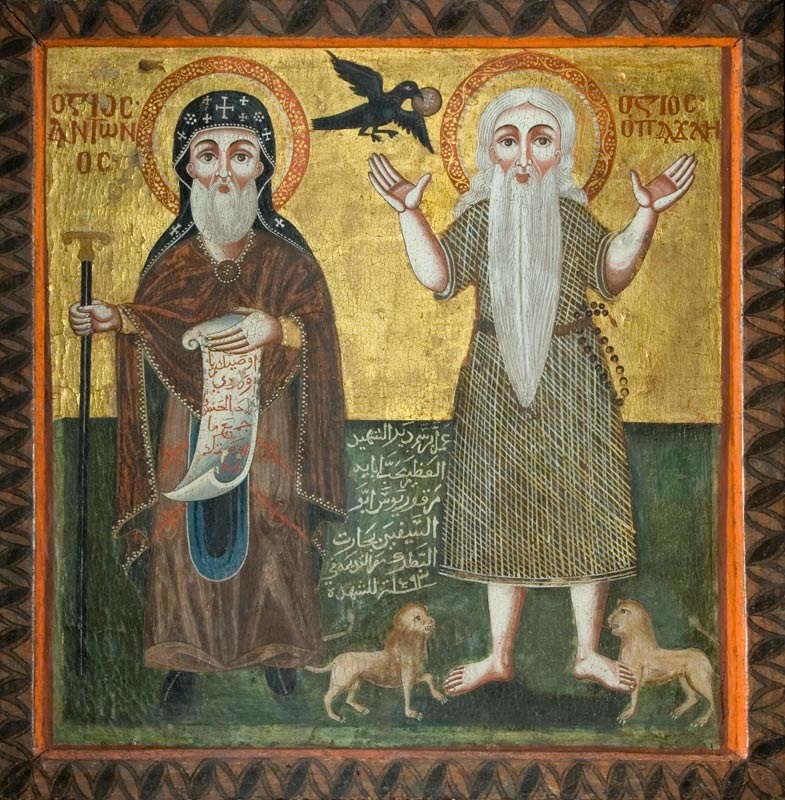
This account is amazingly close to the
temptations suffered by
St. Antony the Great in the Egyptian desert.
But this is not surprising, because their
Christianity - which is to say, their monastic
life - was primarily influenced by and formed by
the Christian monasticism of the Egyptian
desert, and only incidentally from the continent
of Europe. This means that Celtic Christians
were more like the Byzantine or Slavic Orthodox
Christians than Latin or Northern European
Christians.
Early this last summer I had an appointment with
a new diabetic specialist. Dr. Jennings was very
intrigued and pleased to meet "a real live
monk", "But," he said, "you don't look like a
monk." I said, "What do you mean, I don't 'look
like a monk'? I have a beard and wear a black
habit." He replied, "Well, you have to realize,
Father, that my only images of monks have been
formed by television commercials-where the monks
are all wearing brown robes, are clean-shaven,
have a bald spot in the center of their heads,
and are advertising either 'Beano' or
computers." I'm afraid this really is the
popular image of monks in our culture, today.
Most of these images are based upon
stereotypical ideas drawn from medieval Western
monasticism and applied to both Celtic and
Orthodox Christian monastics: it's assumed that
we all look like Francis of Assisi, and live in
great stone monasteries with cloisters. But this
is not an accurate image of Celtic. Rather,
Celtic monastic communities were more a
relatively modest 'monastic village' than a huge
complex of buildings. The village had a stone
wall around it to keep animals in and thieves
out. Within the walls were many small huts,
whether wooden buildings or crude structures of
mud and wattle. Later, especially in the west of
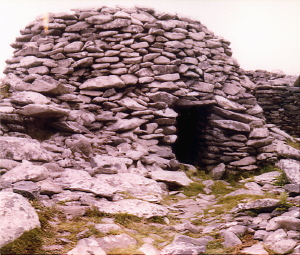
Ireland, stone buildings were erected. Remains
of many "stone clochans, called 'beehive
huts' in English, are scattered over the
countryside....There is no indication that any
large church buildings were ever built...."
(Timothy Joyce, Celtic
Christianity)
Stone clochan, Ireland
"Other monks and nuns lived out their days
alone....in small wood-and-mud huts; they kept a
cow or two, and accepted gladly the gifts of an
occasional loaf or basket of vegetables from
local farmers. The desire for a solitary life
and time to spend simply yearning for God...must
have drifted through the hearts of even the
busiest abbot in the most bustling monastery."
(Bitel, op.cit.)
Monastic life was seen as an absolutely
essential part of Christian life-the norm for
all Christian life, not the exception-, and
monks and nuns, hermits and hermitesses were the
great heroes of the common people, who saw them,
as St. Guthlac put it, as "tried warriors who
serve a king who never withholds the reward from
those who persist in loving Him."
(Quoted in Bitel, Ibid.)
Indeed, it is this quality of persistent, even
stubborn heroism that particularly stamps the
character of Celtic Christianity and,
particularly, monastic life - for these were a
people whose heroes were monks and nuns, not
political leaders or other cultural figures.
St. John Cassian, who is still carefully
read and studied by Eastern Orthodox monastics
today, was well known to Celtic monks. St. John
had spent years as a monk in Bethlehem and
Egypt-and recorded his conversations with the
Egyptian Fathers--later establishing a monastery
near present-day Marseilles, France. The Life of
the Egyptian Father, St. Anthony the Great was
translated into Latin around the year 380, and
we know that this was studied by Celtic monks,
who depicted St. Anthony and St. Paul of Thebes
on some of the great Irish "High Crosses" (about
which I'll say more, shortly).
There was phenomenal literacy and very high
culture among these monks. In addition, they
also learned from the monks of the Egyptian
desert how to practice daily "Confession of
Thoughts." Their monastic clothing was primarily
made from animal skins, so that in appearance
they actually resembled St. John the Baptist out
in the wilderness - a far cry from the monastics
of Europe in their sometimes rather elaborate
woven cloth habits.
Now we come to the interesting part: There are
records of any number of Christians traveling to
the Desert Fathers from the British Isles, and
an old Celtic litany of the saints mentions
seven Egyptian monks who came to Ireland and
died and were buried there. Scholars believe
that most of the contact between Ireland and
Egypt occurred before the year 640. On an
ancient stone near a church in County Cork,
Ireland, there is the following inscription:
"Pray for Olan, the Egyptian. Also interesting
is the fact that even though there are no
deserts in the British Isles, the Celts called
their monastic communities diserts or "deserts."
This was particularly true of island monasteries
or hermitages -those spiritual fortresses-- ,
where the sea itself was like a desert, as an
ancient poet said of St. Columban's island
hermitage:
"Delightful I think it to be in the bosom of an
isle on the peak of a rock, that I might often
see there the calm of the sea...That I might see
its heavy waves over the glittering ocean as
they chant a melody to their Father on their
eternal course."
We have a wonderful description of a visit to
the monks of Egypt near the close of the fourth
century, written by Rufinus of Aquileia. He
wrote: "When we came near, they realized that
foreign monks were approaching, and at once they
swarmed out of their cells like bees. They
joyfully hurried to meet us." Rufinus was
particularly struck by the solitude and
stillness of life among these monks. "This is
the utter desert," he observed, "where each monk
lives alone in his cell....There is a huge
silence and a great peace there."
(Quoted in Celtic Saints,
Passionate Wanderers, by Elizabeth Rees)
St. David of Wales lived in the 6th century.
He came from a monastery which had been founded
by a disciple of St. John Cassian. So great is
St. David that he deserves a whole lecture to
himself, but today I'll just mention him in
connection with the wisdom of the Egyptian
desert: he possessed the gift of tears, spoke
alone with angels, subdued his flesh by plunging
himself into ice cold water while reciting all
of the Psalms by heart, and spent the day making
prostrations and praying. "He also fed a
multitude of orphans, wards, widows, needy,
sick, feeble, and pilgrims."
(Edward C. Sellner, Wisdom of the Celtic Saints)
The Roman Catholic scholar, Edward Sellner,
adds: " Thus he began; thus he continued; thus
he ended his day. He imitated the monks of Egypt
and lived a life like theirs."
(Ibid.) The same
writer assures us that "because of its [the
Celtic Church's] love of the desert fathers and
mothers, it has a great affinity with the
spirituality of the Eastern Orthodox [today]."
There are many other evidences of Eastern and
Egyptian contact and influence, too numerous to
list now. But in his interesting study,
The Egyptian Desert in the Irish Bogs,
Fr. Gregory Telepneff mentions also the
fascinating interlacing knots and complex
designs found on the famous standing High
Crosses, which show Egyptian or Coptic
influence. "Celtic manuscripts show similarities
to the Egyptian use of birds, eagles, lions, and
calves....In the Celtic Book of Durrow, one can
find not only a utilization of the colors green,
yellow, and red, similar to Egyptian usage, but
also 'gems with a double cross outline against
tightly knotted interlacings,' which recall the
'beginnings of Coptic books.'
[Henry, Irish Art]. There is at least
one instance of the leather satchel of an Irish
missal and the leather satchel of an Ethiopian
manuscript of about the same period which
"resemble each other so closely that they might
be thought to have come from the same workshop'
[Warren, Liturgy]."
(Telpneff)
Culturally, then, I suggest that Celtic culture
was a unique and intriguing blend of Egyptian
and other Middle Eastern influences with native
or indigenous cultural elements.
Before going further I want to say a few words
about the term "spirituality." In our time this
has become a wastebasket word into which we put
whatever we want the word to mean. Our English
word, "spirituality", comes from the French, and
originally described someone who was clever,
witty, or perhaps even mad! But our ancient
Christian ancestors, whether from Russia,
Europe, the Middle East, or the lands of the
Celts, did not have such a concept. Certainly
they did not see spiritual life as something
separate from the rest of life. For them,
spirituality was how they lived, how they
prayed, how they worshiped God-and it was all
bound up together, not separated out. Today,
however, we have managed to artificially
compartmentalize ourselves and our lives, making
"spirituality" something that we do in addition
to or separate from regular life. This has made
possible a very artificial approach to the
Celts.
Thomas O"Loughlin, one of the best of our
present-day writers on the subject of Celtic
Christianity, makes the following sage
observation in his book, Journeys on the Edges:
"In the last decade interest in the attitudes
and beliefs of the Christians of the Celtic
lands in the first millennium has swollen from
being a specialist pursuit among medievalists
and historians of theology into what is
virtually a popular movement. In the process
more than a few books have appeared claiming to
uncover the soul of this Celtic Christianity in
all its beauty....[Many writers] operate by
offering their own definitions of 'Christianity'
past and present, and then setting these against
their definition of 'Celt' or 'Celtic'. In this
way they can reach the conclusion they want."
Typical of our modern arrogance and
intellectual-spiritual poverty, we project our
own feeble ideas back onto a more robust and
spiritually rich time, treating the world of
Celtic Christianity like a smorgasbord, where we
take those things we happen to already "like,"
and put them together to form our own very
distorted and sometimes even perverted "version"
of the Celts. An example: It is a fact that in
the early Christian centuries, Ireland, Scotland
and parts of Wales were never subject to Roman
rule-neither the old Roman Empire nor the Church
of Rome held sway over "Celts." But some modern
writers interpret this to mean that Celtic
Christians, since they were "non-Roman," were
therefore anti-Roman or even anti-authority and
against the idea of an organized, patriarchal
Church. There is absolutely no evidence for such
a conclusion, although in fact Celtic Christians
did have a quite different way of organizing
communities than did Christians on the
continent-but this was not out of rebellion, but
because their own models were from Egypt and the
East, not from Europe! The simple fact is that
"the Irish church had always been at the edges
of Roman Christianity, [and considered to be a]
a barbarian church of limited interest to the
Popes." (Paul Cavill,
Anglo-Saxon Christianity: Exploring the Earliest
Roots of Christian Spirituality in England)
"Although the climate and situation of Britain
were very different from the hot deserts of
Egypt, there were principles-simplicity, prayer,
fasting, spiritual warfare, wisdom, and
evangelism-that were easy to translate to the
communities of these isles."
(Michael Mitton, The Soul of Celtic Spirituality
in the Lives of Its Saints) But this
means that entering into the spiritual, mental,
emotional, and physical world of a Celtic
Christian monk is difficult-not impossible, but
difficult.
First we must realize that the Celts had no
concept of privacy or individuality such as we
have today. Families did not live in separate
rooms, but all together; no one thought about
the idea of "compartmentalizing space" and only
hermits and anchorites felt a calling to be
alone in spiritual solitude with God, although
monks had separate cells, just as monastics did
in the Egyptian Thebaid. The idea that people
are separate individuals from the group was not
only unheard-of, but would have been considered
dangerous, even heretical. Self-absorption,
"moods," and being temperamental-all of these
things would have been considered abnormal and
sinful. It wasn't until the 13th and 14th
centuries that people in the West started
keeping journals or diaries, and there were no
memoirs-also signs of individuality and privacy,
of singling oneself out from the family, group,
or community-nor were there actual real-life
portraits of individuals, until the 14th
century. (The art of realistic portraiture
developed in response to the medieval idea of
romance-for an accurate portrait was a
substitute for an absent husband or wife.)
Furthermore, "'the dominant institution of
Celtic Christianity was neither the parish
church nor the cathedral, but the monastery,
which sometimes began as a solitary hermit's
cell and often grew to become a combination of
commune, retreat house, mission station...school
[and, in general] a source not just of spiritual
energy but also of hospitality, learning, and
cultural enlightenment." (Ian
Bradley, quoted in Mitten, Ibid.) It
was only much later that people began to be
gathered into separate parishes, and even later
before bishops had dioceses that were based on
geographical lines rather than just being the
shepherd of a given tribe or group, "being
bishops of a community, rather than ruling areas
of land. The idea of 'ruling a diocese' was
quite foreign to the Celtic way of thinking."
(Ibid.)
If you think about what all of this means in
terms of how we today view ourselves, the world
in which we live, and the values that we have
today, you can see how difficult it's going to
be for us to enter into the world of the Celts.
Today we are quite obsessive about such things
as privacy and individuality, of "being our own
selves" and "getting in touch with the inner
man" and other such self-centered nonsense. But
the Celtic Christian understood, just as did and
do Eastern Christians, that man is saved in
community; if he goes to hell, he goes alone.
So the orientation of those Christian Celts to
God and the other world was very different than
the orientation of our modern world, no matter
how devout or pious we may be, and this makes
the distance between us and the world of Celtic
monasticism far greater than just the span of
the centuries. A renowned scholar, Sir Samuel
Dill, writing generally about Christians in the
West at this same period of time, said: "The dim
religious life of the early Middle Ages is
severed from the modern mind by so wide a gulf,
by such a revolution of beliefs that the most
cultivated sympathy can only hope to revive in
faint imagination ....[for it was] a world
of...fervent belief which no modern man can ever
fully enter into....It is intensely interesting,
even fascinating...[but] between us and the
early Middle Ages there is a gulf which the most
supple and agile imagination can hardly hope to
pass. He who has pondered most deeply over the
popular faith of that time will feel most deeply
how impossible it is to pierce its secret."
(Quoted in "Vita Patrum", Fr.
Seraphim Rose)
But is it really "impossible"? To enter their
world-the world of Celtic Christianity, which is
the same as Celtic monasticism--we must find a
way to see things as they did-not as we do
today-; to hear, taste, touch, pray, and think
as they did. And this is what I mean by the word
"spirituality"-a whole world-view. We must
examine them in the full context of their actual
world-which was a world of Faith, and not just
any Faith, but the Christian Faith of Christians
in both the Eastern and Western halves of
Christendom in the first thousand years after
Christ. Spirituality is living, dogmatic,
theology. This is the only way we can begin to
understand how Celtic Monasticism can be a model
of sanctity for us living today, more than a
millennium after their world ceased to be.
Remember, I said it would be difficult to enter
their world; difficult, but not impossible...
When we speak of someone or something being a
"model," what do we mean? In this
instance-speaking about Celtic monasticism as a
"model"-we mean something that is a standard of
excellence to be imitated. But here I'm not
speaking of copying external things about Celtic
monasteries-such as architecture, style of
chant, monastic habit, etc., which are, after
all cultural "accidents." I'm speaking of
something inward, of an inner state of being and
awareness. It's only in this sense that Celtic
monasticism can be, for those who wish it, a
"model of sanctity."
But what do I mean by "sanctity"? We must be
careful not to slip into some kind of vague, New
Age warm "fuzzies" which are more gnostic than
Christian and have more to do with being a
"nice" person than encountering the Living God
in this life. By sanctity I mean what the Church
herself means: holiness—which is nothing more or
less than imitation of Christ in the virtues,
and striving to die to oneself through humility,
so as to be more and more alive to Christ,
successfully cutting off one's own will in order
to have, only the will of Christ, as St. Paul
says in his epistle to the Galatians (2:20): "I
am crucified with Christ: nevertheless I live;
yet not I, but Christ liveth in me... " So,
holiness means dying to oneself and especially
to one's passions, more and more, so as draw
closer and closer to the Lord God Himself,
through Jesus Christ, and Him crucified and
risen. In addition, Celtic Christians had the
concept of "hallowing" or "hallowed"-an old
fashioned term that today has survived only in
the unfortunate pagan holiday called "Halloween"
(from "All Hallows Eve"-which began as the vigil
for the Western Feast of All Souls Day and later
took on vile pagan overtones). To early British
Christians, something or someone that was
"hallowed" was "set apart" from others and
sanctified for service to God. Thus, a priest's
ordination or a monastic's tonsuring was his
"hallowing."
And so, thus it was that those blessed and
hallowed monastics of Celtic lands modeled forth
certain principles that we can still see, study,
understand, and imitate today.
The Celts were masters of Christian simplicity.
Nowadays there is a movement in our culture to
recover some simple basics, but the model is
often that of the Quakers or the Shakers or the
Amish. Perhaps that's because those groups are
easier and more attractive to imitate; I don't
know. For the Celts, however, simplicity wasn't
so much a question of externals-like furniture,
architecture, and so forth. It was something
internal, and it was founded upon the Lord's
Prayer-in particular the phrase, "Thy will be
done", as we find in the later commentaries of
the
Venerable Bede of Jarrow and Alcuin of the
court of Charlemagne. This was crucial to living
a simple Christian life: "Thy will be done"
meant God's will, not our own--placing absolute
trust in the Providence of God for
everything-one's health, one's finances, the
size of one's family or the size of a monastic
community-everything. It meant dying to oneself,
not having opinions and not judging others. This
was where simplicity began, and from there it
easily expressed itself in outward forms, such
as not owning five tunics when just two or even
one would be sufficient.
Simplicity did not necessarily mean "plainness,"
as we'll see shortly when we look at the
intricate sacred art of the High Crosses. Celtic
Christians were not "Plain People," like Quakers
or the Amish. But they were "Simple People," in
that they were single-minded and intensely
focused on the other world and the journey
through this life to God.
In common with all Christians at that time, the
Celts had no concept of "private prayer" in the
sense of spontaneously thinking of words or
phrases to say to God. This practice belongs to
a much later period in Christian history, when
ideas of privacy and individualism had become
more important than traditional ways of seeking
God through prayer. This didn't mean that a
Celtic Christian didn't pray outside the divine
services, but for them, prayer was primarily
liturgical, and this meant the Psalms. Most
monks and nuns memorized the complete Psalter.
Occasionally a particularly gifted monk would
compose a prayer, such as the one I read by St.
Columban at the beginning of this lecture. But
in moments of need one remembered verses and
phrases from the Psalms -such as "In my distress
I cried unto the Lord, and He heard me," from
Psalm 120, and "Hide not Thy face from me, O
Lord, in the day of my trouble" (Psalm 10, or"In
the Lord I put my trust" (Psalm 11).
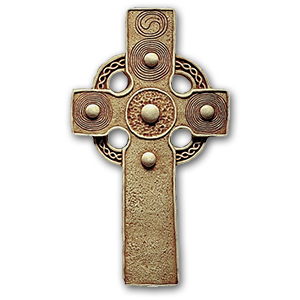
Central to Celtic Christian culture was the
Cross.
Even in the 7th and 8th centuries there were
so-called Christians who were uncomfortable with
the Cross of Christ and chose to ignore it, just
as there are today. The Celts, however, had a
particularly clear-headed understanding of the
Cross. To quote Sister Benedicta Ward, a
renowned scholar on the subject of the Desert
Fathers as well as monasticism in the British
Isles in the early Christian centuries: "The
Cross was not something that made them feel
better, nicer, more comfortable, more
victorious, more reconciled to tragedy, better
able to cope with life and death; it was rather
the center of the fire in which they were to be
changed." (op.cit.)
It reminded them that they must pick up and
carry their own crosses in this life and follow
Christ, for dying to oneself has always been the
great secret of holiness.
Thus, these monks and nuns saw themselves as
warriors of the spirit, for to die to oneself
was considered a greater act of heroism than
dying on a battlefield in defense of one's
tribe. "The Celtic Church was a Church of
heroes...of strong and fiercely dedicated men
and women." "The old Celtic warrior spirit was
alive in them, [but now] put to the service of
the Gospel and the following of Christ, the High
King. Today [we might] find it hard to identify
many [such] warrior Christians...[with] the
active virtues of courage, strength,
outspokenness, decisiveness, and the ability to
stand up for something."
(Joyce, op.cit.)
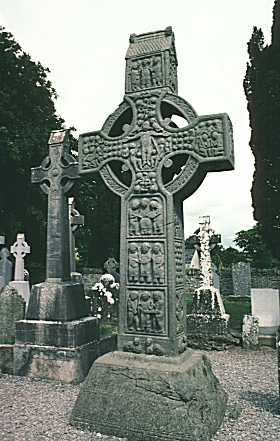
Nowhere was the Cross more loved and cherished
than in the monasteries, where highly-carved and
richly symbolic great "High Crosses"-some of
them 15 feet and taller-- were set up-many of
them still standing today.
These were not the suffering and bloody
crucifixions found later in the West,
particularly in Spain and Italy. Nor were these
the serene and peaceful crosses of the Eastern
Church. No, Celtic crosses were a genuine
Christian expression all their own. Sometimes
Christ is depicted, but often not; however, when
He is shown, He is always erect, wide-eyed, and
fully vested like a bishop, a great High Priest.
In this form He is a symbol of victory over sin
and death; He radiates invincibility.
"The way of the cross for [Celtic Christians]
was the way of heroic loyalty, obedience, and
suffering. It involved study and thought,
doctrine and orthodoxy, art and imagination. It
was a complete, unified way of life, lived
intimately with God....[Our] fragmented modern
world, both secular and religious, has a lot to
learn from it." (Cavill,
op.cit.)
A common ascetic practice, even for the laity,
was called crosfhigheall or
"cross-vigil", and it consisted of praying for
hours with outstretched arms. St. Coemgen
sometimes prayed in this position for days. Once
he was so still, for so long, that birds came
and began to build a nest in his outstretched
hands.
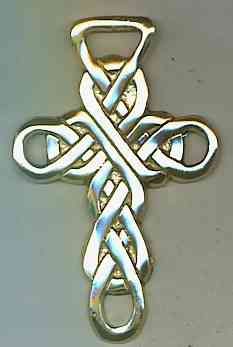
Scholars believe that the Celtic High Cross
patterns probably came from Egypt. There are no
loose ends in these patterns; this symbolizes
the continuity of the Holy Spirit throughout
existence-for God has no beginning and no end.
An example of the love and respect they had for
the Cross may be seen in an Anglo-Saxon poem,
"The Dream of the Rood" ("rood" being an Old
English word for "rod" or "pole", sometimes it
also meant "gallows"). In the "The Dream of the
Rood," Jesus Christ, the Second Person of the
Blessed Trinity, is shone as a "serene and
confident young hero...[who] prepares for
battle. He strips...and climbs up on the gallows
[the Tree of the Cross], intent on saving His
people. He is in control, self-determining,
expressing His lordship [And] the Cross
trembles at the fearful embrace of its Lord."
(Cavill, op.cit.)
Listen, now, as the Cross, personified, speaks
of how it raised up Christ:
"Unclothed Himself God Almighty when He
would mount the Cross,
courageous in the sight of all men. I bore
the powerful King, the Lord of heaven;
I durst not bend. Men mocked us both
together. I was bedewed with blood.
Christ was on the Cross. Then I leaned down
to the hands of men and
they took God Almighty."
(Ward, Ibid.)
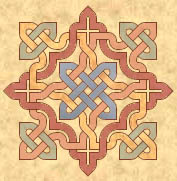
The interlacing, knot-work, plaiting, weaving
patterns and spiral designs, with animals and
plants and saints, and scenes from Scripture,
which decorate almost every surface of a Celtic
High Cross, are so distinctive and profound in
their symbolism that they are a study all to
themselves. Today I can only point out a couple
of things.
Scholars believe that these incredibly complex
patterns probably came from Egypt, but also may
have some Byzantine influences. It's important
to note that there are no loose ends in these
patterns; this symbolizes the continuity of the
Holy Spirit throughout existence - for God has
no beginning and no end; only Christ is the
Alpha and the Omega. The same is true of
knot-work patterns, which are endless and cannot
be untied. Spiral designs symbolized the Most
High God Himself, the "motionless mover," around
whom all things move. Some of these are what are
called "Crosses of the Scriptures" because they
are decorated with panels illustrating scenes
from the Bible. High Crosses possess an almost
dream-like quality in their complex geometric
patterns, dignified and strong, heroic and
towering over men, and yet also reminding those
Christians of the Christian doctrine of kenosis,
the self-emptying of Christ.
One of main factors contributing to the eventual
decline and dissolution of a Celtic monastery
was when the Cross began to no longer be a
focus. "If monastic life...did not have at its
center the reality of the Cross, it became a
source of corruption....[for] 'Once a religious
house or order cease[d] to direct its sons to
the abandonment of all that is not God and
cease[d] to show them the narrow way...it [sank]
to the level of a purely human institution and
whatever its works may be they are the works of
time and not of eternity.'"
(Dom David Knowles, quoted in Ward, Ibid.)
An essential dimension was asceticism (askesis)
which, for the Celtic monk consisted of a kind
of martyrdom. "A homily in archaic Irish,
probably dating from the last quarter of the
seventh century...speaks of [this]: 'Now there
are three kinds of martyrdom, which are
accounted as a cross to a man, to wit: white
martyrdom, green and red martyrdom. White
martyrdom consists in a man's abandoning
everything he loves for God's sake, though he
suffer fasting or labor therat. Green martyrdom
consists in this, this, that by means of fasting
and labor [a Christian] frees himself from his
evil desires, or suffers toil in penance and
repentance. Red martyrdom consists in the
endurance of a cross or death for Christ's sake,
as happened to the Apostles...'...For this
reason, the Celtic tradition regarded
monasticism as the Army of Christ (Militia
Christi) and the monk as a soldier of Christ
(miles Christi). Young men, in their effort to
emulate the heroism of their ancestors, entered
monasteries-the "Green Martyrdom." Instead of
fighting in the Fianna (the Celtic army), they
joined the Militia Christi to wage war against
the evil spirits and sin."
(Fr. Gorazd Vorpatrny, op.cit.) Not
surprisingly, one writer calls these Celts
"Ascetic Superstars." (Bitel,
op.cit.)
"I should like a great lake of ale for the
King of Kings;
I should like the angels of heaven to be
drinking it through time eternal!"
-
St. Brigit of Kildare
And yet, with all of this sober asceticism, the
Celts never lost their native enthusiasm,
exuberance, and just plain cheer, as we see in a
prayer written by the wonderful 5th century
Abbess, Brigit, when she exclaims: "I should
like a great lake of ale for the King of Kings;
I should like the angels of heaven to be
drinking it through time eternal!" How could
anyone fail to be charmed by such a character -
a woman who was a great leader of monastics,
both men and women, who was baptized by angels,
got out of an arranged marriage by plucking out
one of her eyeballs, and fell asleep during a
sermon given by the incomparable
Equal-to-the-Apostles,
St. Patrick!
Finally, the Celts were Trinitarian Christians
par excellence. This is partly because even
before they were Christian they already thought
in terms of threes. And for them-unlike most
Christians today-the Trinity was very real, very
alive, not something vague and theoretical. What
one scholar calls a "Trinitarian consciousness"
(Joyce, op.cit.)
completely shaped everything about them. As
another has said: "'We are here at a central
insight of Celtic theology....Christ comes not
to show up or illuminate the deformity of a
fallen world but rather to
release a beautiful and holy world from bondage
an affirmation, difficult but possible, of
[that] which is the created image of the eternal
Father and the all-holy Trinity.'"
(Noel Dermot O'Donoghue, quoted
in Joyce, op.cit.) "To follow the
spiritual world-view of the Celtic Christians is
to embrace a way of life that is a real
commitment to the belief that the Trinitarian
God is alive in this world." In the Celtic
world, "Jesus Christ is our hero, our sweet
friend....The Father is High King of heaven, a
gentle and beneficent father, a wise and just
ruler. The Spirit is a tangible comforter and
protector ....This God is never to be reduced to
the 'man upstairs' or anyone we can capture and
box in. And yet this wonderful, mysterious God
is close to us....[This] God is extremely
good." (Ibid.)
Brothers and sisters: the sanctity of Celtic
monastics is a model for us in that it combines
heroism and joy in perfect and beautiful
balance. For them, the heroic life was one
completely dedicated to living intimately with
the God-Man whom they described as "victorious,"
"mighty and successful," "the lord of
victories," a great warrior to whom they pledged
undying, fearless, creative and exuberant
loyalty. And yet, for all of their heroism,
their monastic world-view, could be 'summed up
as the 'Christian ideal in a sweetness which has
never been surpassed.'" (Nora
Chadwick, quoted by Joyce in op.cit.)
To slip into their world, even for just a few
moments, as we've done here this afternoon, is,
I believe, is not just inspiring; it's almost
breathtaking.
Just as I began my talk today with a prayer of
St. Columban of Iona, I would like to conclude
with another prayer from this great Celtic
monastic saint:
Prayer of St. Columban of Iona
Lord, Thou art my island; in Thy bosom I
rest.
Thou art the calm of the sea; in that peace
I stay.
Thou art the deep waves of the shining
ocean.
With their eternal sound I sing.
Thou art the song of the birds; in that tune
is my joy.
Thou art the smooth white strand of the
shore; in Thee is no gloom.
Thou art the breaking of the waves on the
rock;
Thy praise is echoed in the swell.
Thou art the Lord of my life;