| Orthodox Outlet for Dogmatic Enquiries | Orthodoxy - the Church |
|---|
The Medicine of Immortality
by Fr. Stephen Freeman
Source: https://glory2godforallthings.com/2025/09/09/the-medicine-of-immortality
|
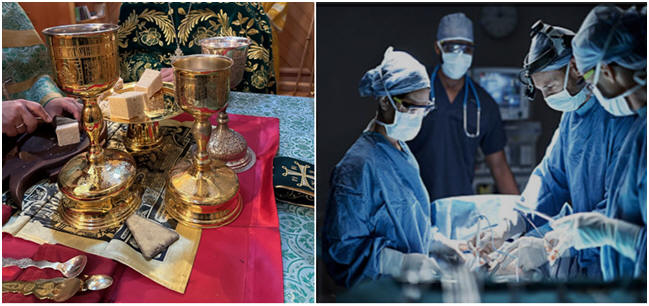
Imagine that you've been brought into a hospital from a terrible wreck.
You're in the ER and there are a team of doctors and nurses standing by
with their amazing array of medical equipment. Also standing nearby is a
team of lawyers, specialists in accident litigation.
Whom do you want to talk to first?
I use this illustration to emphasize the nature of the human problem: we
are sick and injured. We do not have a legal problem. There is nothing
that a team of lawyers can do to make you well or make you recover from
your injuries. A hospital is a place for healing. It is not a courtroom.
The Church is a hospital for sinners. It is a thought with various
attributions - but it speaks definitively and correctly about the nature
of salvation.
In the parable of the Good Samaritan, a man is beaten and robbed and
left by the roadside. Various religious figures ignore him. A Samaritan
(whom the Jews saw as enemies) stops, pours wine and oil on his wounds,
and takes him to an inn, gives the innkeeper two denarii, and says:
"Look after him, and when I return, I will reimburse you for any extra
expense you may have."
The Orthodox understanding of the parable has always seen the Good
Samaritan as a figure of Christ. The injured man is a figure of us all.
Sin has beaten us up, robbed us, and left us by the side of the road.
I can think of only one figure in the gospels who came to Jesus with a legal problem.
“Then one from the crowd said to Him, “Teacher, tell my brother to
divide the inheritance with me.” But Jesus said to him, “Man, who made
Me a judge or an arbitrator over you?”” (Luke 12:13–14)
In the parable of the Good Samaritan, the inn to which the injured man
is taken has been seen as the Church. The Church is a hospital. He is
there for healing.
It should be noted that what takes place is a process. Legal
transactions are instantaneous: you are declared "not guilty!" Much of
contemporary Christianity was formed and shaped in a culture in which
the juridical metaphor was everything. The great revivals of the 19th
century, the fountainhead of many denominations, were predicated on
immediate decisions and rapid Baptisms. Some would cite examples from
the Book of Acts as the pattern for such actions - while those stories
serve a different purpose in their telling.
What we know is that the early Church quickly developed a pattern of
initiation and conversion that stretched over a period of one to three
years (the "catechumenate"). Today's catechumenate is often a year-long
process. But the life of salvation (our time in the Church-as-hospital)
lasts a lifetime.
This is where an understanding of sin as wound and sickness is helpful.
At its heart, sin is "death working in us." We did not create this
process of death - it is the outcome of our broken communion with God.
The things that we do wrong (often referred to as "sins") are symptoms
of the death-working-in-us.
The work of healing is the life of prayer, forgiveness, participation in
the sacraments, and our transformation in and through the love of God.
“This is the message which we have heard from Him and declare to you,
that God is light and in Him is no darkness at all. If we say that we
have communion (koinonia)
with Him, and walk in darkness, we lie and do not practice the truth.
But if we walk in the light as He is in the light, we have communion (koinonia)
with one another, and the blood of Jesus Christ His Son cleanses us from
all sin. If we say that we have no sin, we deceive ourselves, and
the truth is not in us. If we confess our sins, He is faithful and just
to forgive us our sins
and to cleanse us from all unrighteousness.” (1 John 1:5–9)
An image that comes to mind when I think of life in the
Church-as-hospital is "marinating." It is the image of "soaking" in a
savory sauce that slowly changes things. We acquire the life of God by
"dwelling" in Him as He dwells in us. It is transformation by communion
rather than transaction. The primary decision of our life in Christ is
to "stay put."
Much of our transactional culture suggests to us that information is the
key to life. Indeed, this has been called, by some, the "Age of
Information." It presumes that our problems can be corrected by
education and a bit more media. We are like people who have developed a
terrible disease who read books (and endlessly Google) while never going
to a doctor or taking medicine. Too often, we imagine that acquiring
correct information about our disease will make the difference.
We have short attention spans. The culture of information and
transaction suggests that our lives can change overnight. Our lives
happen a day-at-a-time, but they are measured in decades and are best
seen in the rear-view mirror.
The parable of the Good Samaritan contains the frequent theme of the One
who has left but will return (like the Landlord in other parables). It
is at the core of the Christian experience. We spend our lives in the
inn - in the hospital of the Church. The Innkeepers (the
under-shepherds) look after us and continue to feed, clean, and tend to
our wounds. Together we await the return of the Good Samaritan who will
reimburse whatever is required at His coming.
This coming, however, is more than an "end of time" event. It is
fulfilled in each Eucharistic gathering. "Unless you eat my flesh and
drink my blood, you have no life in you," He tells us. But that eating
and drinking is always something we do with Him in His Kingdom. It is
the feast of love in which our wounds and sins (death itself) are
swallowed up in His freely-given Life.
“I am the bread of life. Your fathers ate the manna in the wilderness,
and are dead. This is the bread which comes down from heaven, that one
may eat of it and not die. I am the living bread which came down from
heaven. If anyone eats of this bread, he will live forever; and the
bread that I shall give is My flesh, which I shall give for the life of
the world.””
(John 6:48–51)
St. Ignatius of Antioch called the Eucharist the "Medicine of
Immortality." |
Article created: 09-09-2025
Last update: 09-09-2025