| Orthodox Outlet for Dogmatic Enquiries | Essays on Orthodoxy |
|---|
by Fr. Stephen Freeman
Source: https://glory2godforallthings.com/2026/04/03/thje-pilgrimage-we-must-learn-to-make/
|
There is a short comment in a letter by St. Gregory of Nyssa
that has raised eyebrows for centuries on the topic of
pilgrimages. Going to a holy place was big business in the
Middle Ages (cf. The Canterbury Tales). Thus this epigrammatic
thought of a Church Fathers, who carried the title, "The Father
of the Fathers," troubled many:
When the Lord invites the blest to their inheritance in the
kingdom of heaven, He does not include a pilgrimage to Jerusalem
amongst their good deeds; when He announces the Beatitudes, He
does not name amongst them that sort of devotion. But as to that
which neither makes us blessed nor sets us in the path to the
kingdom, for what reason it should be run after, let him that is
wise consider.
He goes on to note the many temptations that were inherent in
travel itself, as well as the moral dangers that were known to
infect the Holy City. A pilgrimage was not on his recommended
list of spiritual undertakings.
I will say up front that I have made a pilgrimage to the Holy
Land. There were things that I expected and some that surprised
me. But there is a great deal of wisdom in St. Gregory's
admonition that is worth considering.
Why do we go on pilgrimage? Is one place holier than another?
Our modern world is awash in tourism. A number of cities
in Europe have begun to place limits on the number of tourists
permitted at any one time lest the crush of people destroy the
very thing which they came to see.
Pilgrimage is not meant to be tourism, though it is frequently
reduced to such a level. Many people are surprised by the
commercialism of the Holy Land, though this was already the case
in the time of St. Gregory.
There is a deeper pilgrimage that the Church encourages and is
available to all. It has no commercialism, nor is it fraught
with temptation. It is quite simple:
The whole world is Passover in Jerusalem in 33 A.D. Everywhere
we go, we are there. In the liturgical life of the Church, the
details of that city, at that time, are drawn out in careful
detail in the services of Holy Week. Every celebration of the
Divine Liturgy is a making-present of that time and that place:
For as often as you eat this bread and drink this cup, you show
forth the Lord’s death till He comes. (1Cor. 11:26)
The Liturgies of the Church are not re-enactments of a
historical moment (the Church is not a religious society for
creative anachronism.) The Church is the Body of Christ, the
mystery hidden from all the ages. When we are Baptized, we are
Baptized into the death and resurrection of Christ, and are
eternally united to the fullness of those events revealed in
death and resurrection of Christ.
As such, Holy Week is the revelation of our life - always and
everywhere. We always sit with Christ at table and are given His
Body and Blood. We are always with Him in the Garden of
Gethsemane, where we watch or fall asleep. Because we are with
Him in the Garden we say, "I will not betray Thee with a kiss as
did Judas." All of the characters who are gathered with Christ
are revelations of our self as well.
We arrest Him. We mock Him and spit at Him. We beat Him. With
Pilate we condemn Him, while meekly washing our hands of the
whole thing.
There is also the deeper mystery in which, as St. Paul says,
"[We] are crucified with Christ." With Christ, we are left to
pray alone. We are betrayed. We are arrested, beaten, tortured,
and condemned. We carry the weight of our cross until it crushes
us. With Christ we discover the joy of a stranger who bears the
weight of our cross in our place.
Crucified with Christ, we find ourselves among thieves and those
who simply refuse to understand. But crucified with Him, we see
His Mother who stands beside us always, even at the hour of our
death.
This pilgrimage is not an act of imagination. That which is
truly "mystical" is not imaginary - it is real and true. It is
the real and true that is hidden and noetically perceived. Seen
by the heart, it is a balm for our wounded souls and a medicine
for the blindness of our false pilgrimages.
St. Gregory's hesitance regarding journeys to Jerusalem was a
concern for the absence of our noetic/mystical perception. To
stand at Golgotha is an interesting historical moment, something
available to unbelievers as well. It does not come with an
objective insistence that we perceive the truth of what we see.
That perception is rooted in the heart and is revealed always
and everywhere.
When Christ spoke of such things He made the nature of His
presence quite clear:
"Inasmuch as you did it (or did it not) unto the least of
these my brethren, you did it (or did not do it) unto me."
The liturgical pilgrimage of Holy Week is a school of the heart.
It is meant to nurture within us a depth perception that allows
us to see what we all too easily overlook. Of course, it is too
rich to take in over the course of a week. But, attend with the
heart and allow Christ to make Himself known. The Liturgy
extends throughout the year. It is the mystery everywhere
present and filling all things.
Come and see.
Elder Paisios of the Holy Mountain
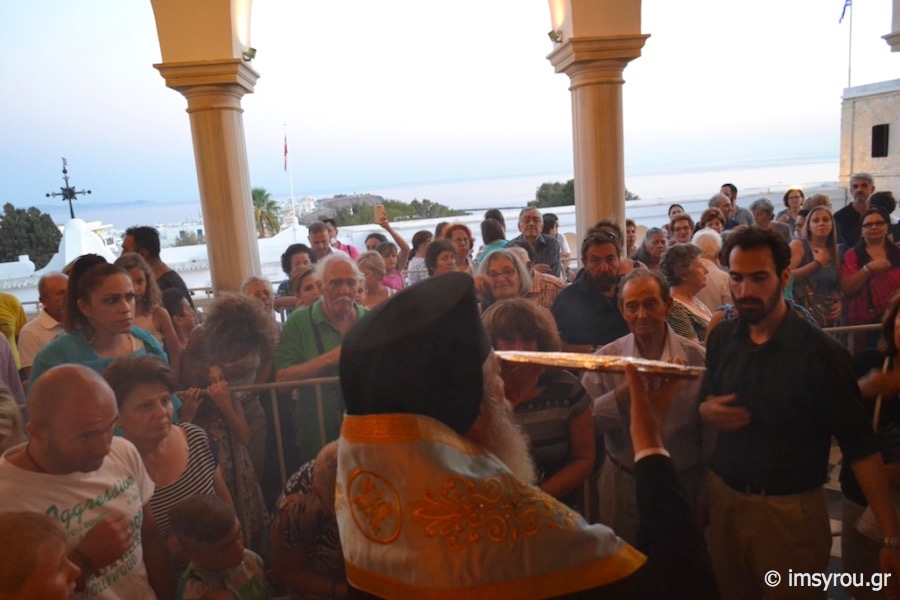
At the Convent of Saints John the Theologian and Arsenios of Cappadocia, where elder Paisios of Mount Athos is buried, at the anniversary of his repose a service for the dead and a Vigil were celebrated, followed by the Divine Liturgy early in the morning. According to the police, 50,000 people prayed at the night service. 120,000 pilgrims visited the elder’s grave on July 12. The church could not hold thousands of worshippers, “including a great number of children”, so they had to pray in the convent’s courtyard.
|
Article created : 04-04-2026.
Last update : 04-04-2026