Franz Kafka famously wrote: “The Lie has become the World Order.” It was
a sobering estimate (by an unbeliever) of the nature of human reality.
Lying, simply not telling the truth, can seem a minor thing. But Jesus
and the New Testament seem to pay a great deal of attention to lying,
and treat it quite seriously. There is more here than the mere
abrogation of a moral tenet. It is a concern with something more
“Kafkesque.”
The nature of truth and lies becomes clear if they are thought of in
terms of being. The Church describes God as the “Author of our being.”
In the writings of the Fathers, being itself, simple existence, is seen
as a good thing, the first of all created good things. God brings us
into existence saying, “It is good.” More than that, the Fathers teach
that it is God’s will that we grow towards “well-being,” with the
ultimately goal of “eternal being.” This, in terms of existence, is the
path of salvation.
And this understanding reveals the nature of a lie: it has no true
existence. That which is not true not only has no existence, but its
very purpose is to obscure or destroy that which indeed has true
existence. Fantasy and imagination, even though they have no true
existence, are by no means inherently false. Only those forms which seek
to distort, deny or destroy that which truly exists can be called “lies”
rather than “fantasy” or “imagination.”
But this makes speech about reality (that which truly exists) very
significant. The most obvious thing we can say is that reality itself
and speech about reality are not the same thing.
In classical philosophy, the school of thought that describes words as
only “in our heads” is called Nominalism. The names (nomina) of things
are described as “nothing more than thoughts.” Those who argued
otherwise (there are various types of such arguments) are called
Realists. Orthodoxy, in its classical form, has always espoused some
form of Realism. There is a relationship between words and thoughts and
that to which they refer that is greater than simply being something “in
our heads.”
One of the places where this debate took shape was in the debate over
the veneration of icons. It is clear that images had played a role in
the life of the Church from very early times. But that role was not
questioned or explored until the 7th and 8th centuries. The debate was
about more than the mere making of images. A greater and more pressing
question was the veneration (giving honor) to the images themselves.
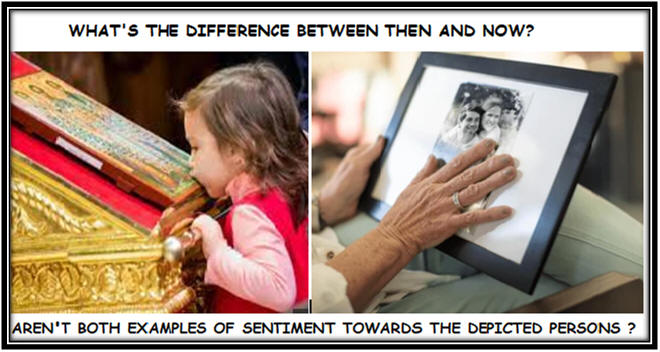
Saint Basil the Great stated a clear connection between the image and
the subject of the image: “Honor given to the image is referred to its
prototype.” Thus the honor given to an icon of Christ was, in fact,
honor given to Christ Himself.
Saint Basil’s statement was something of a simple assertion, without
elaboration. But in the 8th and 9th centuries, Saint Theodore the
Studite developed a much more careful treatment of the question. He
described an icon as a “hypostatic representation,” that is, a
representation of the personal or particular characteristics of its
subject (the personal is always
considered
particular rather
han general or abstract). He further taught that what is represented is
“hypostatically” present in the image. The image does not become what is
represented – that would be a presentation of its essence. Instead,
it makes present what is represented, i.e., the Person.
Saint Theodore’s treatment used the language that the Church had
developed for speaking about the Holy Trinity, as well as the Person and
Nature of Christ to speak about the Holy Icons. It is a treatment that
is often forgotten or neglected.
Saint Theodore’s teaching on this question manages to avoid Nominalist
solutions. He does not say, “It’s just a picture.” He does not say,
“It’s only connection to what is depicted is in the mind.” Like all of
the Fathers, he is a Realist. There is a true, even ontological,
relationship between the icon and its subject. But he avoids charges of
“magic” by maintaining that what is represented is only hypostatically
present.
His explanation makes it possible to say, “The man in the picture is
Peter.”
Turning back to language, the same understanding says that words matter.
They have an actual relationship with the reality of which they speak
and it matters. Fr. Georges Florovsky once said that “doctrine is a
verbal icon of Christ.” Or, as the Seventh Council said, “Icons do with
color what Scripture does with words.”
Of course, the palette of language is far richer than the palette of the
artist. Words have “shades” of meaning and subtle hues that an artist
should envy. But, in the teaching of the Orthodox faith, words have a
grounding in reality beyond psychology.
Some have said that the modern world is inherently Nominalist. We
believe that our words are only words, and only have meaning because we
say or think they do. The “reality” they describe is, therefore, in our
minds. There was a school of thought (Idealism) that held that there is
no objective reality outside the mind, or certainly that it cannot be
proved. That extreme position has never gained acceptance. However, the
modern sociology of knowledge, in which perceptions, prejudice, etc. are
given a dominant and controlling position, yields something of the same
effect. Conversation begins to falter in the face of withering doubts
about the reality or trust-worthiness of anything in our heads.
Words have something of a sacramental relationship with the reality they
represent. Or, to be more precise, they have an iconic relationship with
reality. Icons are not photographs, nor can words ever serve as a
photographic or holographic substitute. But icons also carry more
information than photographs and are able to make associations and
connections that reveal the truth of reality (its foundational reality)
far more profoundly than is possible in a photograph.
Words have that same ability. Take the poetic sentence:
"What
rough beast, its hour come round at last, slouches towards Bethlehem to
be born?
No photograph (and perhaps no icon) could carry as much information as
this combination of words from Yeats’ “The Second Coming.” The many
associations of “beast” (including the Beast of Revelation) do not
“approach” – they “slouch.” It carries overtones of “slither” (and the
serpent of the Garden) as well as other emotional content. And so the
analysis would continue. It is a phrase that lives in my mind, capturing
a reality both present and yet to come.
And this brings us back to lying. The struggle to speak the truth
transcends mere morality. At its most fundamental level, it is a
struggle to rightly relate to and participate in reality itself. To
“live a lie” borders on not living at all – and is a synonym for hell.
To claim that the reality of our words lives only in the mind is itself
a “lie” (not an intentional one, but simply not true). And even the
photographic presentation of reality (as in all literalisms) fails to
rise to the status of truth.
The Fathers held that the world-to-come (the Eschaton) was the truth.
The Old Testament, they said, was a shadow, while the New Testament was
an icon.
As verbal beings, we live in a world of icons. We experience the world
in an iconic fashion. A major difficulty for us is that we have lost the
vocabulary of iconic reality. We have substituted the language of
photography.