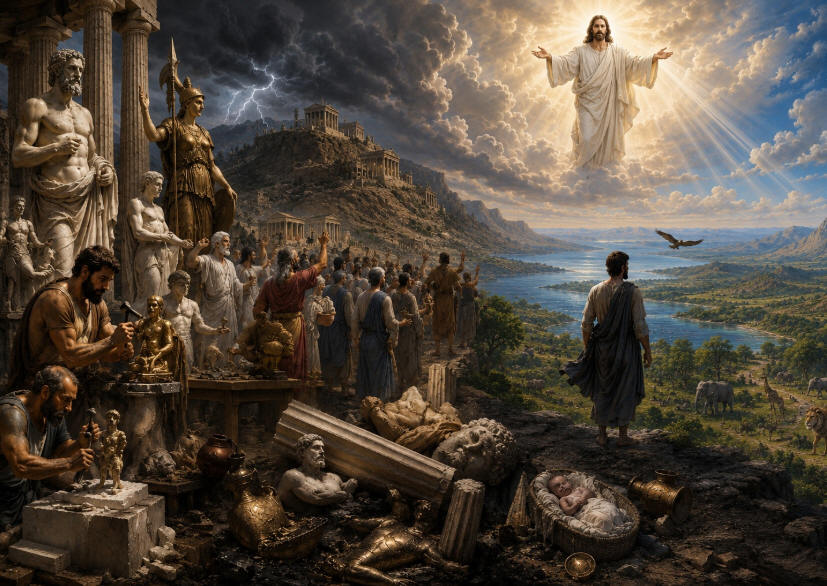
 Source: Theophilos of Antioch Book 2 - Ch.1-4 - PG
6, 1048-1053
Source: Theophilos of Antioch Book 2 - Ch.1-4 - PG
6, 1048-1053
|
Exodus 20:3-5: " 3 you shall not have other gods besides Me. 4 You shall not make for yourself an idol, nor any likeness of all things that are in the sky above and on the earth below and all that are in the waters below the earth. 5 You shall not bow to them nor worship them, for I am the Lord your God." ******** Chapter I.—Autolycus an Idolater and Scorner of Christians.
A fluent tongue and an elegant style afford pleasure and
such praise as vainglory delights in, to wretched men who have been
corrupted in mind; the lover of truth does not give heed to
ornamented speeches, but examines the real matter of the speech,
what it is, and what kind it is. Since, then, my friend, you have
assailed me with empty words, boasting of your gods of wood and
stone, hammered and cast, carved and graven, which neither see nor
hear, for they are idols, and the works of men’s hands; and since,
besides, you call me a Christian, as if this were a damning name to
bear, I, for my part, avow that I am a Christian, and bear this name
'beloved of God', hoping to be serviceable to God. For it is not the
case, as you suppose, that the name of God is hard to bear; but you
possibly entertain this opinion of God, because you are yourself yet
unserviceable to Him.
Chapter II.—That the Eyes of the Soul Must Be Purged Before God Can Be Seen. But if you say, “Show me your God,” I would reply, "Show me yourself, and I will show you my God.” Show, then, that the eyes of your soul are capable of seeing, and the ears of your heart able to hear; for as those who look with the eyes of the body perceive earthly objects and what concerns this life, and discriminate at the same time between things that differ, whether light or darkness, white or black, deformed or beautiful, well-proportioned and symmetrical or disproportioned and awkward, or monstrous or mutilated; and as in like manner also, by the sense of hearing, we discriminate either sharp, or deep, or sweet sounds; so the same holds good regarding the eyes of the soul and the ears of the heart, that it is by them we are able to behold God. For God is seen by those who are enabled to see Him when they have the eyes of their soul opened: for all have eyes; but in some they are overspread, and do not see the light of the sun. Yet it does not follow, because the blind do not see, that the light of the sun does not shine; but let the blind blame themselves and their own eyes. So also thou, O man, have the eyes of your soul overspread by thy sins and evil deeds. As a burnished mirror, so ought man to have his soul pure. When there is rust on the mirror, it is not possible that a man’s face can be seen in the mirror; so also when there is sin in a man, such a man cannot behold God.
Do you, therefore, show me yourself, whether you are not an
adulterer, or a fornicator, or a thief, or a robber, or a purloiner;
whether you do not corrupt boys; whether you are not insolent, or a
slanderer, or passionate, or envious, or proud, or supercilious;
whether you are not a brawler, or covetous, or disobedient to
parents; and whether you do not sell your children; for to those who
do these things God is not manifest, unless they have first cleansed
themselves from all impurity. All these things, then, involve you in
darkness, as when a filmy defluxion on the eyes prevents one from
beholding the light of the sun: thus also do iniquities, man,
involve you in darkness, so that you cannot see God.
Chapter III.—Nature of God.
You will say, then, to me, “Do you, who see God, explain
to me the appearance of God.” Hear, O man. The appearance of
God is ineffable and indescribable, and cannot be seen by eyes of
flesh. For in glory He is incomprehensible, in greatness
unfathomable, in height inconceivable, in power incomparable, in
wisdom unrivalled, in goodness inimitable, in kindness unutterable.
For if I say He is Light, I name but His own work; if I call Him
"Logos", I name but His sovereignty; if I call Him "Nous", I speak
but of His wisdom; if I say He is Spirit, I speak of His breath; if
I call Him Wisdom, I speak of His offspring; if I call Him Strength,
I speak of His sway; if I call Him Power, I am mentioning His
activity; if Providence, I but mention His goodness; if I call Him
"Realm", I but mention His glory; if I call Him Lord, I mention His
being judge; if I call Him Judge, I speak of Him as being just; if I
call Him Father, I speak of all things as being from Him; if I call
Him Fire, I but mention His anger. You will say, then, to me, “Is
God angry?” Yes; He is angry with those who act wickedly, but He is
good, and kind, and merciful, to those who love and fear Him; for He
is a chastener of the godly, and father of the righteous; but he is
a judge and punisher of the impious.
Chapter IV.—Attributes of God.
And He is without beginning, because He is unbegotten; and He is
unchangeable, because He is immortal. And he is called God [Θεός] on account of His having placed [τεθεικέναι] all things on security afforded by Himself; and on account of [θέειν], for θέειν means
running, and moving, and being active, and nourishing, and
foreseeing, and governing, and making all things alive. But he is
Lord, because He rules over the universe; Father, because he is
before all things; Fashioner and Maker, because He is creator and
maker of the universe; the Highest, because of His being above all;
and Almighty, because He Himself rules and embraces all. For the
heights of heaven, and the depths of the abysses, and the ends of
the earth, are in His hand, and there is no place of His rest. For
the heavens are His work, the earth is His creation, the sea is His
handiwork; man is His formation and His image; sun, moon, and stars
are His elements, made for signs, and seasons, and days, and years,
that they may serve and be slaves to man; and all things God has
made out of things that were not into things that are, in order that
through His works His greatness may be known and understood.
|
