|
1. Therefore let those who support the contrary - that is, those who
speak against their
salvation - tell us:
Regarding the dead daughter of the synagogue head,
(1)
the
widow’s dead son, who was being carried out near the city gate, (2)
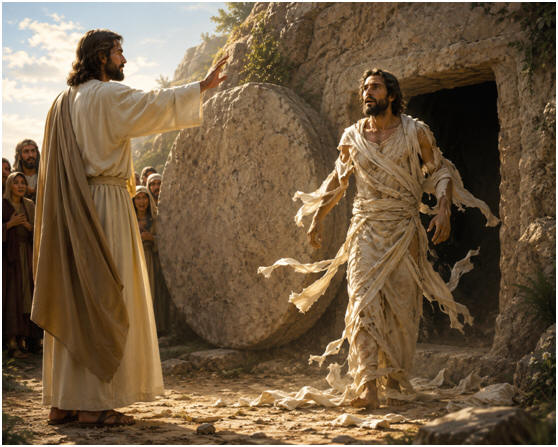
and Lazarus, who had been in the tomb for four days(3): with what
bodies were they resurrected? Definitely the ones they had died
with, because, if it was not with their own bodies, then obviously those deceased ones were
not resurrected.
Thus, as the Gospel says, “The
Lord took the hand of the dead man, and said to him: ‘young man, I
am telling you, get up’. And the dead man sat up, and He ordered
that something be given him to eat; and He delivered him to his
mother.(4)”
And to Lazarus He “called
out with a loud voice, saying, ‘Lazarus, come outside!’, and the
dead man came out, with his feet and hands bound with bandages."
(5) This symbolizes man who was bound by sins, and that is why the
Lord then said, “Unbind
him, and let him go."(6)
So, those who have been cured had been cured in the members that
were previously afflicted, and the dead were thus resurrected, with
the same bodies, because their limbs and their bodies had received
the cure and the life that the Lord gave. With temporal things He
would prefigure the eternal things, and thus showed that it is He
who can give His creation both the cure and the life, so that we may
believe. Also, in his word regarding resurrection, it will be likewise during the End when the Lord will cry out “in the last trumpet call" (7) that the dead shall be resurrected, as He Himself says: “The hour shall come, in which all the dead who are in the tombs shall hear the voice of the Son of man, upon which, those who have done good deeds shall proceed to the resurrection of life, and those who have done evil deeds shall proceed to the resurrection of judgment."(8)
2. They are truly foolish and miserable, who do not want to notice
such clear and obvious things, but instead avoid the light of truth,
and – like the tragic Œdipus - blind themselves.
Heretics resemble those who were not practised in wrestling in the
pit, so, when they quarrel with others, they firmly grasp a part of
their [opponent’s] body; but by grasping it they fall - yet even
when falling, they imagine that they are victorious, because by
being disputatious, they keep holding on to the part that they
grabbed at the beginning; however, besides falling, they also become
laughing stocks.
Thus, with regard to Paul’s verse, that: “Flesh
and blood are not able to inherit the kingdom of God;"(9)
heretics remove two words without previously examining the meaning
of the Apostle’s words, nor the power of his words; thus, by
re-constituting the abstract meanings by themselves, they die with
them, and, as much as they can, they overturn God’s entire Oikonomia
(Providence).
3. They actually assert that this was said of the flesh, and not of
the works of the flesh, as we mentioned. They thus present the
Apostle as contradicting himself. For immediately after, in the same
Epistle, he says in reference to the body: “For
this corruptible thing must don incorruptibility, and this mortal
thing must don immortality. And when this mortal thing shall have
donned immortality, then shall be brought to pass the written word:
death is swallowed up unto victory. O death, where is thy sting? O
Hades, where is thy victory?”(11)
Now these words shall be
rightly said, when this mortal and corruptible body -which is
engulfed and dominated by death- shall receive life and shall don
incorruptibility and immortality. For
then, indeed, shall death be truly vanquished, when that body which
it possessed will leave its dominion.
And he also says to the Philippians: “...for our polity
exists in heaven, on account of which we accept the Lord Jesus as
Saviour – Who will transform the body of our humiliation, making it
conformable to the body of His glory, enabling it according to the
energy of His power.”(12) What, then, is this “body of
humiliation” which the Lord will transform, making it conformable to
“the body of His glory?” It is obviously our body, our flesh, which
is indeed humiliated when it descends into the earth.
The transformation however of the body entails that albeit being
mortal and corruptible, it becomes immortal and incorruptible - not
on account of its own hypostasis, but on account of the power of the
Lord, for He is the one who can give immortality to the mortal and
incorruptibility to the corruptible. That is why he says: “so
that the mortal be swallowed up by life. And the one who shaped us
into this very thing is God; Who gives us the betrothal of the
Spirit.”(13)
It is clearly evident that he says these things about the body,
given that neither the soul nor the spirit can die.
In other words, it is the
mortal thing that disappears from life, because the body does not
remain dead but becomes alive and incorruptible and praises God who
did this to us. So, it
is in order that we become perfected that he rightly says to the
Corinthians, “Glorify
God in your body.”(14) God is the
cause of incorruptibility. 4. However, it is because he says these things - not about a certain other body but for that very same body, the flesh - that he very clearly and without any doubt or hesitation says to the Corinthians: “We always carry around the dying of Jesus in our body, so that the life of Jesus Christ will be revealed in our body. We the living forever deliver ourselves to death through Jesus, so that the life of Jesus will also be revealed in our perishable flesh.”(15) And because the spirit joins itself to the body, he says in that same Epistle: “...for you are an epistle of Christ, ministered by us, inscribed not by ink, but by the Spirit of the living God - not in stone tablets but in fleshy tablets of the heart.”(16) Therefore, if fleshy hearts have now become receptive of the Spirit, what is so wondrous if - during the resurrection - they receive the life that the Spirit gives? It is about this resurrection that the apostle speaks in his Epistle to the Philippians: “By being conformed to His death, I shall somehow end up in the resurrection of the dead.”(17) Therefore In which other mortal flesh can we understand that life is revealed, if not in our own hypostasis - which is even put to death for its confession of God? Just as he again says: “If I as a human had fought against beasts in Ephesus, what is my benefit, if the dead are not raised?”(18) “For if the dead are not raised, then neither was Christ risen. And if Christ was not risen, then our preaching is empty, and your faith is empty. We also find ourselves as false witnesses of God for having testified that He raised up Christ, whom He had not raised. For if the dead do not rise, then neither was Christ risen. And if Christ was not risen, your faith is futile, as you will again be in your sins. Therefore also those who had slept in Christ will be lost. If we have hope in Christ only in this life, then we are more pitiful than all men. But now Christ has risen from the dead as the first-fruits of those who have slept; for, just as death was through man, through a Man will be the resurrection of the dead.”(19)
5. For all of the above, therefore - as we said earlier –they will
either say that the Apostle contradicts himself regarding the
statement that “Flesh
and blood cannot inherit the kingdom of God;”(20)
or, again, they will necessarily make perverse and falsified
interpretations of his words, in order to overturn and alter the
meaning of those words.
Because they will have nothing to say if
they attempt to interpret differently what he writes: “For
this corruptible thing must don incorruptibility, and this mortal
thing must don immortality..”(21) and “so
that the life of Jesus will also be revealed in our perishable
flesh” (22) – as well as all the other
words by which the Apostle obviously and clearly proclaims the
resurrection and incorruptibility of the flesh - so that they are
compelled to misinterpret all of them, simply because they do not
want to correctly understand one thing.
***********************
FOOTNOTES
(1)
Matth.9:18
-
Μark
5:22
-
Luke
8:41.
The Evangelists speak of “αρχισυνάγωγος”
in the original Greek text – meaning chief or head of a synagogue,
and not a “high priest” (αρχιερέας).
(2) Luke
7:12.
(3)
John 11:39.
(4)
Matth. 9:25, Luke 7:14-15, 8:55.
(5) John
12:17; 11:43-44.
(6) John
11:44.
(7) 1
Cor.
15:52.
(8) John
5:28-29.
(9) 1
Cor.
15:50.
(10)
John of Damascus, on the Sacred Parallels. Issued by
Halloixius
(as per the subsequent one).
(11) 1
Cor.
15:53-55.
(12) Phil.
3:20-21.
(13) 2
Cor. 5:4-5.
(14) 1
Cor.
6:20.
(15) 2
Cor.
4:10-11.
(16) 2
Cor.
3:3.
(17) Phil.
3:10-11.
(18) 1
Cor.
15:32.
(19) 1
Cor.
15:13-21.
(20) 1
Cor.
15:50.
(21) 1
Cor.
15:53.
(22) 2
Cor.
4:11.
English rendition by A.N. |
