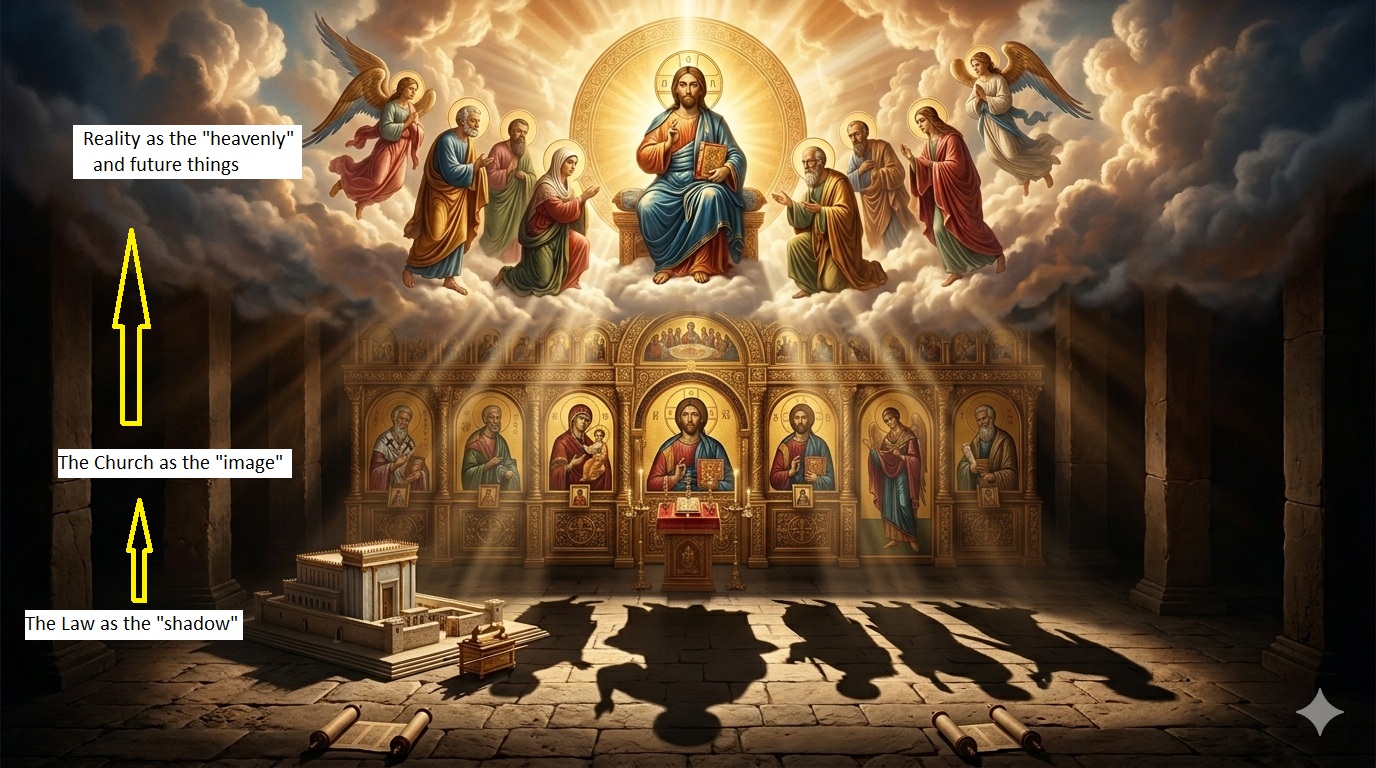
Source: Comments by Saint Maximus the Confessor on the work
“Regarding Ecclesiastic Hierarchy” by Saint Dionysios the Areopagite
Chapter 3, part 3, para.2 (PG 4, 137D).
|
****************
The Hebrews 10:1 verse
In his commentary on the work “Regarding
Ecclesiastic Hierarchy” by Saint Dionysios the Areopagite, Saint
Maximos has Orthodoxically interpreted this verse, as he has done
with texts by many other Fathers, as follows:
The nature of Saint Maximus’ “Commentaries”
Saint Maximus the Confessor had written
the “Commentaries” on the works of Saint Dionysios the Areopagite.
Their structure resembles today’s “memoranda” or “marginal notes.”
Maximus would read Dionysius’ text and, wherever he found a
difficult or enigmatic term, he would write a short, concise
elucidation.
It is for this reason that this text is not an organic part of Saint
Dionysios’ main text, nor does it comprise an original, continuous
analysis by Maximus. It is a “fragmentary” Commentary; it is an
independent, interpretative insertion, whose purpose is to shed
light on a specific term by Dionysios.
This particular passage functions as an interpretative key.
Dionysios often speaks in an exceptionally abstract way about the
movement of the mind, from the “perceptible” to the “intelligible.”
With this commentary, Maximos comes to provide a practical
theological “mapping” of this heavenward movement:
Dionysius uses the term “causal” (things that arise from a cause).
Maximos intervenes and “unlocks” the term, by referencing the
biblical form (From the Old Testament, to the New Testament, to the
Future Era), in order to make the Dionysian “hierarchical ascent”
better comprehended.
It is a synthesis. Maximos combines Dionysios’ terminology (causal,
archetypes, tangible-intellectual), and the Patristic tradition on
Hebrews 10:1 (shadow-image-truth), which was widely known during his
time (Origen, Gregory of Nyssa and Chrysostom had already used it).
By noting in Dionysios’ margins, Maximus
sought to ensure that the reader would not be lost in abstract
philosophical concepts, but would understand that the ascent to God
is not simply an intellectual exercise, but a movement within the
Church, which begins from the “shadow” of the Law and ends in the
“truth” of the Future Realm.
Ν. Μ.
|
