O.O.D.E. Orthodox Outlet for Dogmatic Enquiry |
Category: Salvation |
In Hell with the Soul
( "Hell" is not a place - it is a state )
by Fr. Stephen Foreman
Source:
https://glory2godforallthings.com/2026/09/08/in-hell-with-the-soul/
|
I have studiously avoided online debates regarding an eternal
hell and the punishment of the wicked. I do not plan to change that
avoidance with this article. However, I believe that hell is important
within Christian believing, though not for the purpose that most
imagine. The famous dictum of St. Silouan is worth noting:
"Keep your mind in hell and despair not."
Most discussions of hell (online and elsewhere) become entangled
in its supposed juridical character. Hell, in this view, is a place of
punishment. It is the pronouncement of justice. The cry for justice, it
is suggested, requires hell as an answer.
I recall the words of St. Isaac of Syria:
"We know nothing of God's justice, only His mercy."
With that in mind, I will leave the juridical framework for
heaven and hell for others to ponder. For myself, I know only God's
mercy.
The Psalmist says it well:
"Lo, if I descend into hell, Thou art there."
How can the Psalmist say such a
thing? It is only possible because the Psalmist himself has stood in
that very place. He speaks of what he
knows and what
he has
seen. And this
conversation that he has with Christ ("Thou") is spoken to us because
we, too, have been there, or, we are there, now.
If we lay aside the juridical framework of hell for a moment,
and consider it in terms of being and existence (an ontological
framework), then hell becomes the name of our non-existence. It is our
non-existence in its relative separation from God.
"In our tradition, when the
human being stands in front of God, he invariably sees himself as dust
and ashes. This death then is the existential realization or experience
of the fact that he is a speck of dust. Indeed, he is a speck of dust
with whom God has fallen in love madly, to which he bows, which he
becomes (deified). Nevertheless, all human beings of all times, all who
have ever lived and all who will ever live, amount precisely to nothing."
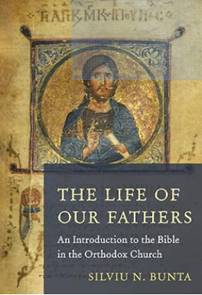
(From
The Life of Our Fathers,
Fr. Silviu Bunta.)
Saint Athanasius makes a similar
point in his
De Incarnatione.
Our nature, he holds, is rooted in nothingness. We exist only as
gift. Apart
from God we begin to move towards the nothing from which we came. That
movement, ontologically speaking, can be described as
hell. It is
from hell that we turn to God in repentance. Consider this:
"...metanoia or 'repentance,'
comes down to the manner in which one relates to his/her life, or more
acutely, to how one relates to his/her powerlessness, suffering, and
death. With metanoia this relationship switches from being sustained and
governed by the ego to being sustained and written by Christ’s life and
death." (Bunta,
Ibid.)
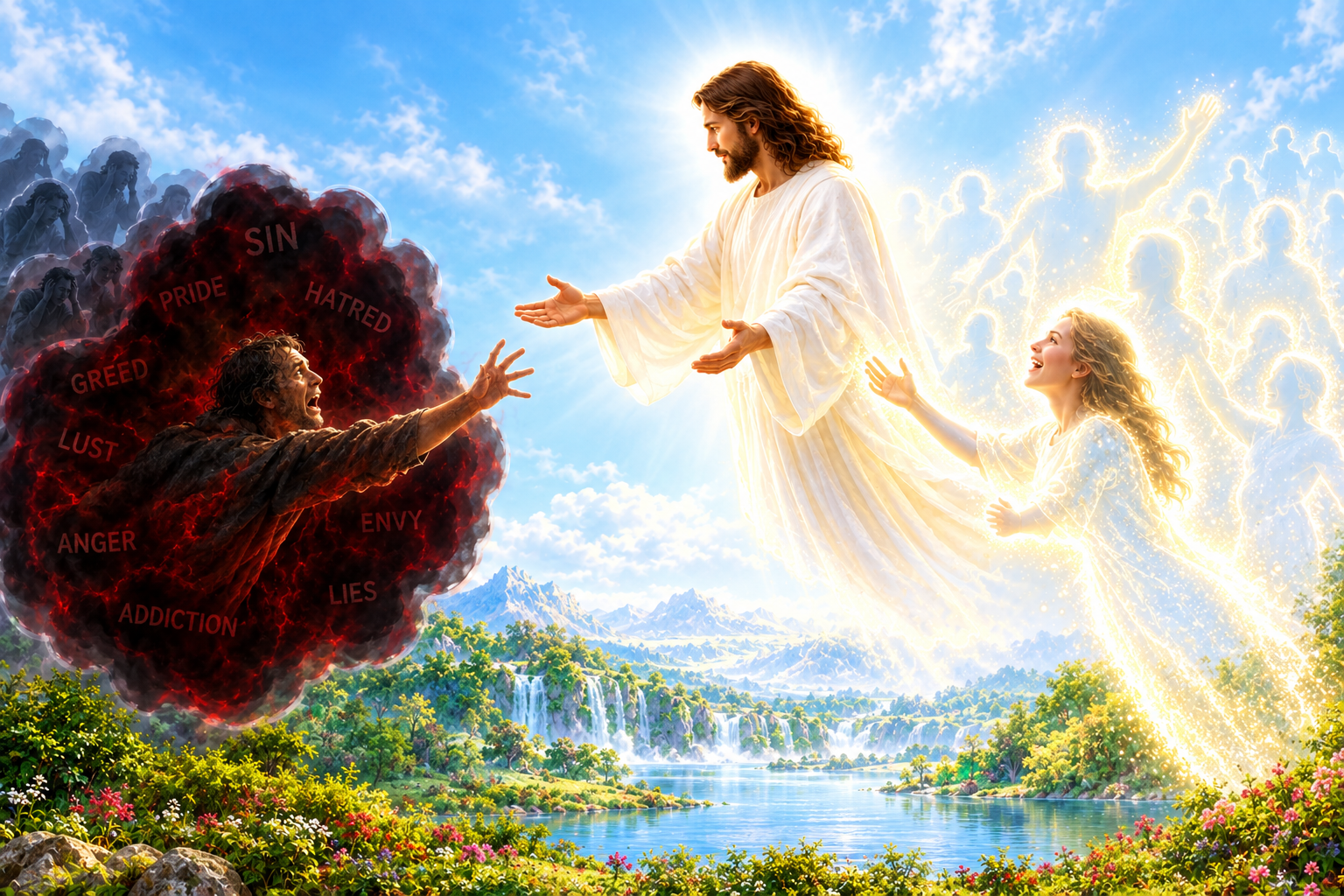
This repentance is imaged for us in the icon of Christ's Descent
into Hades that is commonly displayed at Pascha. In it, Christ rescues
Adam and Eve from their bondage in hell. The icon is not a historical
depiction as such. But it shows the action of Christ in His Pascha. Adam
and Eve are the whole of humanity. St. Silouan wrote the poem, "Adam's
Lament." It is Adam's cry from Hades.
Where art Thou, O Lord? Where art
Thou, my Light? Why hast Thou hidden Thy face from me?
This hinders Him: Christ-like
humility and love for my enemies are not in me. God is love insaturable,
love impossible to describe.
Understood in this way, "hell" (or
"Hades"), is a
necessary part
of understanding the human condition. It is the emptiness of our
condition revealed by the fulness of God who alone is true Being. Hell
is the nakedness of our condition that we seek to avoid at all costs -
creating disguise after disguise that can never hide that nakedness.
In Christ, we see God-become-man voluntarily enter that
nakedness. Naked on the Cross before the eyes of all, “He turned not
His face from the spitting and the shame.” (Is. 50:6)He did not
refuse the alienation we imposed upon Him so that He might go to the
very place of our alienation to bring us home.
“[God] made Him to be sin who knew no sin, that we might
become the righteousness of God.” (2Cor. 5:21)
“God became man, so that man
might become god.” St. Athanasius, "De
Incarnatione
The truth of our existence is found in God Himself, in our union
with Him. In Him, with Him, and through Him, we are created for
paradise, for the fullness of being that is God Himself.
The iconography of the Orthodox faith makes clear that Christ’s
entrance into our world is an entrance to a human condition that
“rhymes” with hell. In the icon of Christ’s nativity, His birth is
pictured as taking place in a cave (and that was certainly the case,
though it was used as a “stable”). In the icon, the cave is depicted in
a manner that copies the “cave” of Hades that can be seen in the Descent
into Hades icon associated with Pascha. That same depiction can
traditionally be seen in the icon of Christ’s Baptism in the Jordan,
where the waters of the Jordan are “hell.” So St. Paul tells us that
those who have been baptized into Christ were baptized into His death.
On a certain level, such revelations can seem abstract and
distant. My baptism was 65 years ago. More immediate are daily struggles
and an inevitable decline in health. None of these things seem to sink
to the level of “hell.” But avoiding hell is not the point. Rather, it
is recognizing the “hell” that is already present in the emptiness and
death of the human condition. It is also the empty place of humility.
But, with the Psalmist, we recognize that “Christ is there.” (“Lo, if I
descend into hell, Thou art there”).
In Vespers, we enter this place and begin to pray:
Lord, I call upon Thee, hear me.
Hear me, O Lord.
Later, we continue:
Bring my soul out of prison That I may give thanks unto Thy
name...
... Out of the depths have I cried unto Thee, O Lord; O Lord,
hear my voice.
Where are we standing when we offer this hymn (a composite of
verses from Psalms 140, 141, 129, and 116 )? Clearly, we are standing in
the depths of hell – the “prison” (the Hebrew word would be better
translated as “dungeon”). Significantly, as the Psalm and its verses are
being sung, the priest comes out of the altar, censing the Church and
the people. As we lift our voices from the place of darkness, Christ
enters into our midst. He comes to save. When this hymn is completed,
the doors of the Holy Place are opened, and the priest enters again with
incense and light, while we sing the hymn, “O Gladsome Light.” It is our
deliverance.
This “liturgy” is repeated again and
again in our daily lives. To my mind, it has been the model of
priesthood – to meet people in the various prisons of the soul, in the
levels of hell within the heart, and to preach the gospel. “The people
who sat in darkness have seen a great light.”
Christ comes to us.
A difficult part of the spiritual life is to recognize the
darkness for what it is and allow Christ to enter. Too often, we flee
the darkness into places of make-believe, the various neuroses that we
falsely treat as a refuge. We should never mistake our neuroses for God.
This is a difficult discipline.
In the Divine Liturgy, just before the service begins, the altar
is censed while these verses are quietly spoken:
In the tomb with the body,
Just so.
Follow Christ...everywhere, through everything. He is there. *********** OODE Note: The above analysis sheds light on why the terms "Hades" and "Hell" are often confused in their meaning. The term "Hades" (aka "Underworld") applies only to the souls, while "Hell" applies to the psychosomatic element, which includes the divinely decided, eternal penalty. Both terms are linked noetically, in that neither one denotes "a place" of any kind that one may imagine (in written or audiovisual presentations); both of them are "states" of the departed human's soul - which is why "Hades" (and even "Paradise" for some!) can be an unbearable situation - a "hellish" one... |
Article created: 10-9-2026
Last update: 10-9-2026